The Whisper Beneath the Arch
Every great structure holds a secret.
Some whisper it through steel and cable, others murmur through stone and shadow.
For centuries, architects built arches by intuition — stacking stones in graceful curves that somehow stood, defying gravity’s pull.
But no one could truly explain why they stood.
Until one day, in the 17th century, a man looked at a hanging chain and saw the shape of an arch turned upside down.
That man was Robert Hooke, and what he saw changed architecture forever.
The Secret Message in the Chain
Hooke was an English polymath — physicist, astronomer, architect, engineer.
He studied everything that bent, stretched, or swayed.
After the Great Fire of London in 1666, Hooke was deeply involved in rebuilding the city.
He observed how cathedrals, churches, and domes all relied on one delicate question:
How can something as heavy as stone stand gracefully under its own weight?
He suspected the answer lay in a humble curve — the shape formed by a chain hanging under its own weight.
But Hooke was a man of riddles.
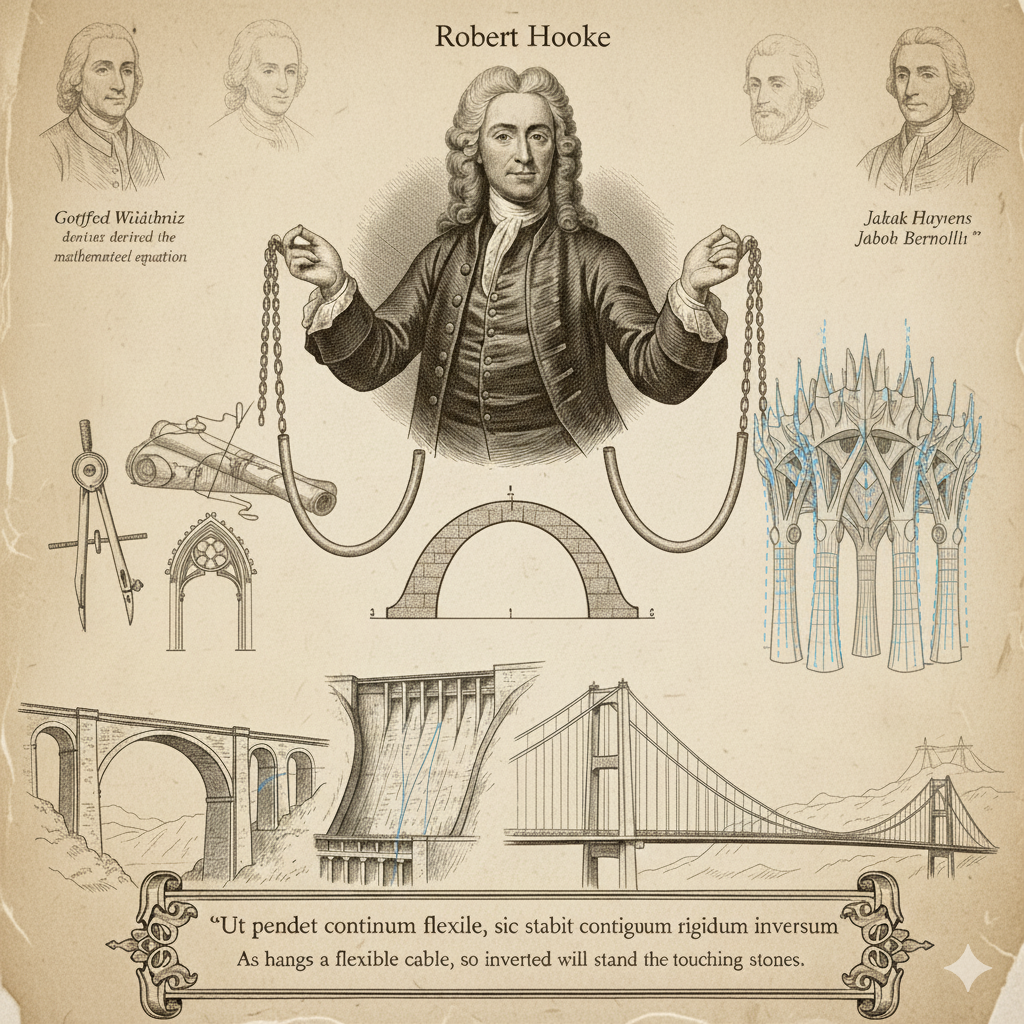
He didn’t publish his discovery directly; instead, in 1675, he sent an anagram to the Royal Society:
“Ut pendet continuum flexile, sic stabit contiguum rigidum inversum.”
(As hangs the flexible line, so but inverted will stand the rigid arch.)
It was his poetic way of saying:
“Turn a hanging chain upside down, and you have the perfect shape for an arch.”
The catenary — from the Latin catena, meaning chain — was born.

The Equation of Grace
Hooke knew the principle, but not the mathematics behind it.
It would take three other great minds — Leibniz, Huygens, and Johann Bernoulli — to put the catenary into an equation.
In 1691, working independently, all three derived the same elegant formula: y=acosh(ax)
Where a defines how tightly the curve hangs — a balance between tension and gravity.
They also gave the curve its name: the catenary — the hanging chain.
For the first time, nature’s curve had a mathematical language.
It wasn’t an ellipse, nor a parabola, nor a circle — it was something more honest:
a curve drawn by gravity itself.

When Gravity Became the Architect
The catenary did more than describe a hanging chain — it revealed how nature carries load.
When a chain hangs freely, every link is in pure tension.
Invert that curve, and every stone in the arch lies in pure compression.
That was Hooke’s revelation:
The same curve that a chain hangs by, a cathedral stands by.
From that day forward, arches were no longer built by trial and error —they were sculpted to the song of physics.

From Cathedrals to Cables
The catenary’s influence stretched far beyond Hooke’s time.
It shaped domes, suspension bridges, and even the curves of modern dams.
- Antoni Gaudí used hanging chains to model the catenary arches of the Sagrada Família.
He hung strings weighted with small bags of sand, photographed the models upside down —
and there it was: nature’s architecture. - Modern suspension bridges — from the Golden Gate to the Akashi Kaikyō — use catenary-shaped cables to hold their decks, following the curve gravity chooses.
- Concrete arches and masonry vaults still obey Hooke’s rule:
as hangs the flexible, so stands the rigid.
Even dam faces and shell roofs borrow its secret — the art of distributing force naturally.
The catenary became the unspoken signature of balance —
where weight, form, and purpose align without conflict.


The Shape That Time Can’t Topple
The beauty of the catenary lies in its honesty.
It doesn’t fight gravity — it collaborates with it.
It doesn’t resist the pull — it flows with it.
In a world where every design races to defy nature, the catenary whispers a quieter truth:
“Strength is found not in opposition, but in harmony.”
The same curve that once hung from Hooke’s hand now lives in our bridges, roofs, and arches — a reminder that sometimes, the most enduring designs are the ones drawn by the forces themselves.
At Kousain, we carry that same principle — to let physics be the pen that draws our designs.
From tensile cables to compression arches, from form-finding to finite elements, we seek that perfect balance — where geometry meets gravity and stability meets grace.
Because every enduring structure, in the end, is a conversation with the forces that built the world.