The River and the Empire
At the dawn of the 19th century, Paris was a city of stone and revolution.
Empires had fallen, kings had returned, and the Seine — calm but eternal — watched it all in silence.
Every bridge that crossed it was made of the same thing: stone.
Heavy, immovable, ancient.
Each one spoke the same language — that strength meant mass, and endurance meant weight.
But then came a new ruler with a restless imagination — Napoleon Bonaparte —
a man who believed that destiny could be built, not inherited.
He wanted a bridge unlike any before it.
Not carved by masons, but forged by men of science.
Not permanent because of stone, but eternal because of innovation.
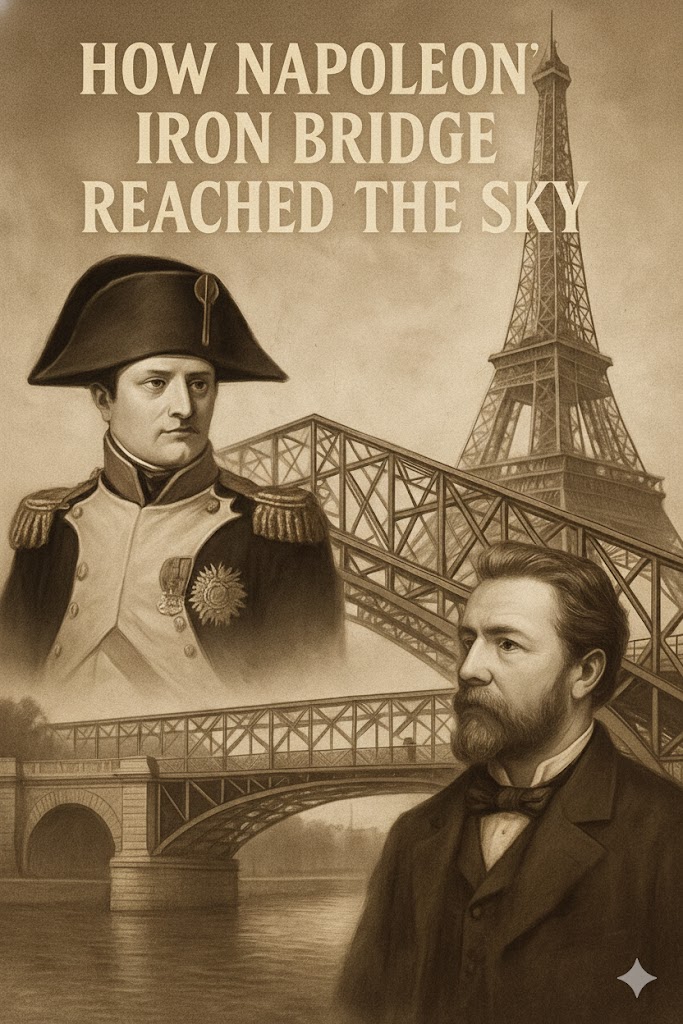
So, in 1801, he ordered the construction of the Pont des Arts —
the first iron bridge ever built in Paris.

The Bridge That Broke Tradition
The engineers, Louis-Alexandre de Cessart and Jacques Dillon,proposed something audacious: a bridge made not of stone blocks,but of cast-iron trusses, light as lace, yet strong as the empire itself.
It would stretch across the Seine in nine delicate spans —
not by resisting the river, but by floating above it like a thread of steel.
When it opened in 1804, Parisians gasped.
Some in wonder, others in fear.
It was too light, too modern — too un-Parisian.
A bridge, they said, should stand like a fortress, not shimmer like a spider’s web.
But when Napoleon walked across it, he smiled.
“This,” he said, “is how empires should build — not heavy, but wise.”

Iron Against Stone
The Pont des Arts was more than a bridge — it was a revolution in disguise.
It was the first time Paris saw iron not as a tool, but as a material of architecture.
It introduced a new faith: that strength could come from geometry, not gravity.
Iron had no grandeur, no mythology — it was the language of the future,
the voice of engineers, not sculptors.
To the artists of the age, it looked mechanical.
To the dreamers, it looked like freedom.
The bridge divided the city.
But history would prove it right.
The Student of Iron
Half a century later, in 1855, a young engineer named Gustave Eiffel arrived in Paris.
He was obsessed with one question:
“How do you make matter light?”
He studied every iron structure in France,
and when he came upon the Pont des Arts, he stopped.
The bridge was old now — rusted, quiet, half-forgotten.
But Eiffel saw something others didn’t: an idea.
Those trusses, those triangles, the elegant balance between compression and tension —they were not decoration. They were the geometry of strength.
He realized that the same principles that held a bridge above water could hold a tower above the earth.
He began sketching.

From the Seine to the Sky
When the world prepared for the 1889 World’s Fair,
France needed a symbol — something that would prove that industry, not empire, was its new glory.
Eiffel proposed a tower — 300 meters tall,
made not of stone or bronze, but pure iron.
Critics mocked him.
They said it would collapse under its own weight,
that it would ruin Paris with its ugliness.
But Eiffel knew what they didn’t —
that iron, arranged with geometry and logic, could do what stone never could:
rise without limit.
Every truss in the tower echoed the Pont des Arts,
every triangle whispered the same law of equilibrium that Napoleon’s bridge had first tested.
The bridge had crossed a river.
The tower would cross an era.
And when the Eiffel Tower finally rose over Paris,
the city of stone became a city of steel.

From Empire to Eternity
The Pont des Arts is quiet now —
a bridge of lovers and locks, not emperors and engineers.
But its legacy lives in every lattice, every rivet, every beam that points toward the sky.
Napoleon wanted to unite two sides of a river.
Eiffel united two centuries of thought.
From the whisper of the Seine to the roar of the storm,
the same message endures:
Lightness is not weakness. Geometry is strength.
And it all began with a bridge —
a bridge that dared to dream of the sky.

At Kousain, we believe engineering is the art of turning weight into wonder.
Like Eiffel and the dreamers before him,
we build not to resist nature, but to think with it —
to find balance between force and form,
between the seen and the calculated.
Because every bridge, every tower, every design we shape begins the same way — with a question that refuses to stay grounded.