When the Skyline Became a Razor
New York has always been a vertical battlefield.
Every generation tried to outbuild the last — taller, sleeker, shinier.
But when the architects of 111 West 57th Street first presented their design,
even the city that built the Empire State blinked.
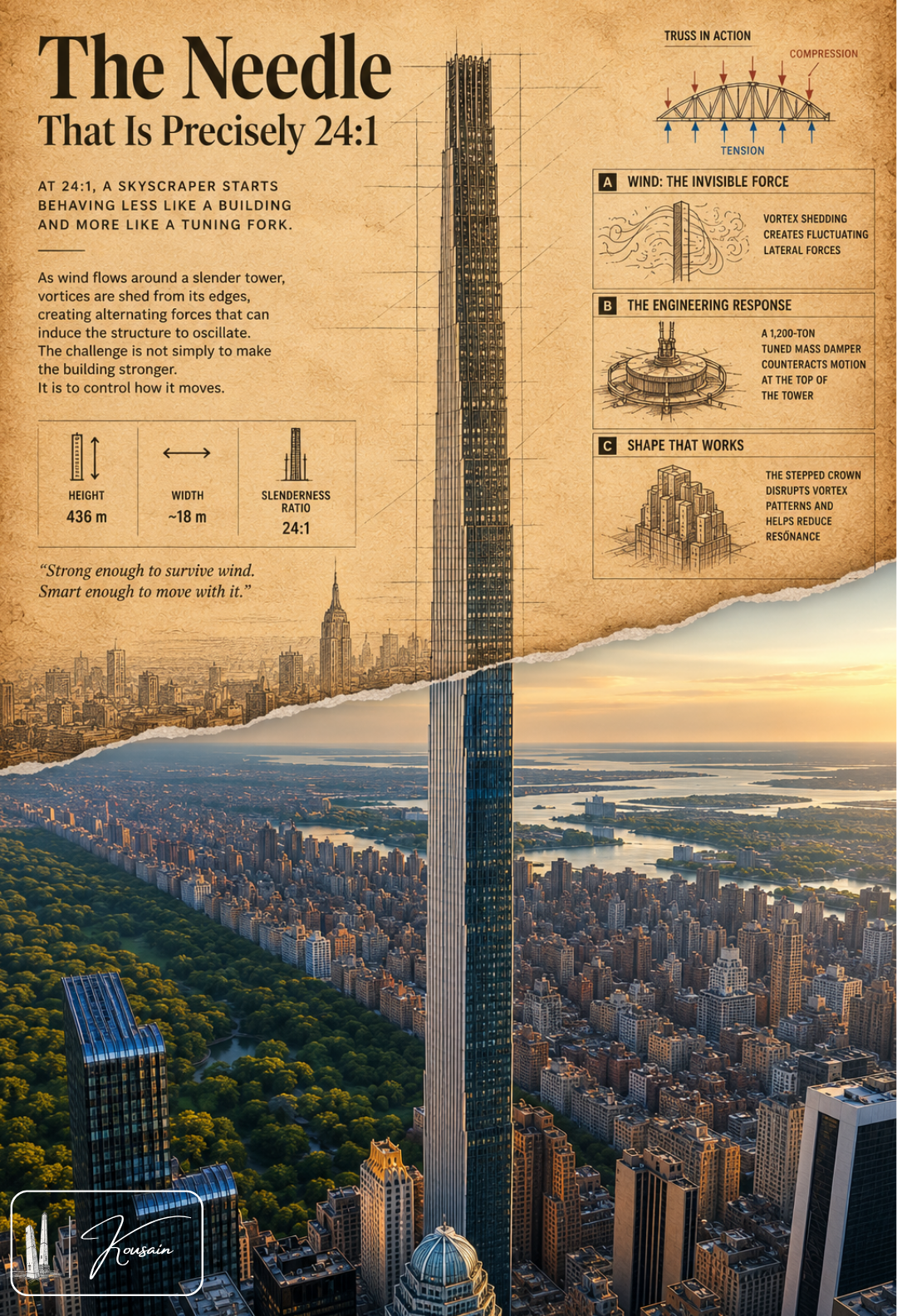
A tower that rises 1,428 feet (approx. 436 m) above Manhattan —
with a width barely 60 feet across (approx. 18.2m)
That’s an aspect ratio of 24:1.
For every 24 meters it climbs, it’s only one meter wide.
To put that in perspective,
that’s taller than the Empire State Building, but as narrow as a townhouse.
They called it Steinway Tower — after the historic Steinway & Sons piano hall it rises from — but what it really is… is an experiment in grace under physics.

The Problem With Being Too Thin
Slenderness is beauty in art — but danger in engineering.
A tall building doesn’t just fight gravity.
It fights the invisible: the wind.
At a 24:1 ratio, the tower behaves less like a building and more like a tuning fork.
Every gust, every change in air pressure can make it sway — not dramatically, but perceptibly. To people on the upper floors, that movement could feel like a slow, dizzying drift.
Worse, slender towers risk vortex shedding —
a rhythmic pattern where alternating air currents push on opposite sides,
setting the structure into oscillation.
It’s not the violence of the storm that threatens them — it’s the rhythm of the wind.
The same physics that can make a bridge hum, can make a skyscraper sing itself apart.


How to Make a Pencil Stand on Its Tip
To stop the wind from dictating the dance, engineers needed something extraordinary.
They couldn’t simply add mass — that would crush the foundation.
They couldn’t change the shape — that would ruin the architecture.
So they began to tune the tower — like the instrument it stands upon.
At the top of Steinway Tower, hidden behind golden ribs of terracotta and bronze,
lies its secret heart: a mass tuned damper —
a 1,200-ton steel weight that moves with precision when the building sways.
When wind pushes the tower one way, the damper slides the other,
its inertia counteracting the motion.
Like a pendulum inside a violin,
it silences the vibration, turning chaos into calm.

The Material Ballet
A structure this slender can’t rely on symmetry alone.
Every column, every floorplate, every ounce of steel must perform in concert.
The core — the tower’s spine — was built from high-strength concrete,
nearly 14,000 psi (around 100MPa), and reinforced with mega-columns at its east and west façades.
This creates a stiff, elastic frame that channels forces down to the foundation without buckling under its own weight.
The exterior walls are not just decorative —
they act as part of the structure, a load-bearing skin.
Each terracotta panel, each bronze mullion adds both beauty and stiffness.
It’s a perfect balance between art and mechanics —
where the marble sings, but the math conducts.

A Foundation for the Impossible
But every skyscraper, no matter how ethereal,
is only as strong as what it stands on.
Beneath 57th Street, engineers had to anchor this needle into Manhattan’s ancient schist — drilling deep rock anchors that extend more than 100 feet into the ground.
Each column sits on massive concrete caissons,
built to resist not just compression but overturning.
The base was also complicated by history —
it had to integrate the original 1925 Steinway Hall,
preserving the façade while embedding new structure through it.
Imagine performing open-heart surgery on a landmark —
while building a skyscraper on top of it.
And yet, they did.

When the Wind Became the Music
As construction climbed, engineers monitored wind tunnel tests with the care of conductors reading a score.
They shaped the tower’s crown not just for looks, but to confuse the wind — its stepped form breaks the uniform vortices that would otherwise cause resonance.
Each architectural “cut” at the top is an aerodynamic note — breaking patterns, scattering gusts, ensuring that no single rhythm can take hold.
By the time it reached its full height in 2021,
Steinway Tower no longer fought the wind.
It danced with it — a harmony of structure and storm.

What the Steinway Tower Really Means
Steinway Tower isn’t just a skyscraper —
it’s a question answered in concrete and air:
“How thin can human ambition stand before it breaks?”
The answer, as it turns out, is 24 to 1.
It’s not an architectural record — it’s a structural confession.
A testament that when physics says “no,”
engineering whispers, “Watch me.”
At Kousain, we see Steinway Tower as the ultimate expression of what structural design can become — not a contest of height, but a negotiation with forces.
We believe elegance is not the absence of difficulty,
but the mastery of it.
From bridges that breathe to towers that sway in rhythm with the wind,
we design where stability meets artistry —
and where the impossible starts to look graceful.
Because every great structure is not about defying nature — it’s about understanding it well enough to stand within its laws.