When the River Refused to Behave
Before Prague had a skyline of spires, it had a problem: the Vltava River.
Beautiful.
Cold.
Unpredictable.
And merciless to bridges.
For centuries, the river tore down every structure men dared to place across it.
Wooden bridges snapped like twigs.
Stone ones cracked under ice.
Flood after flood rewrote the map of Prague.
So when the Judith Bridge collapsed in 1342, the city faced a crisis:
either surrender to the river…
or build something the river could not unbuild.
King Charles IV chose the latter.
He didn’t just want a bridge.
He wanted a statement of permanence.
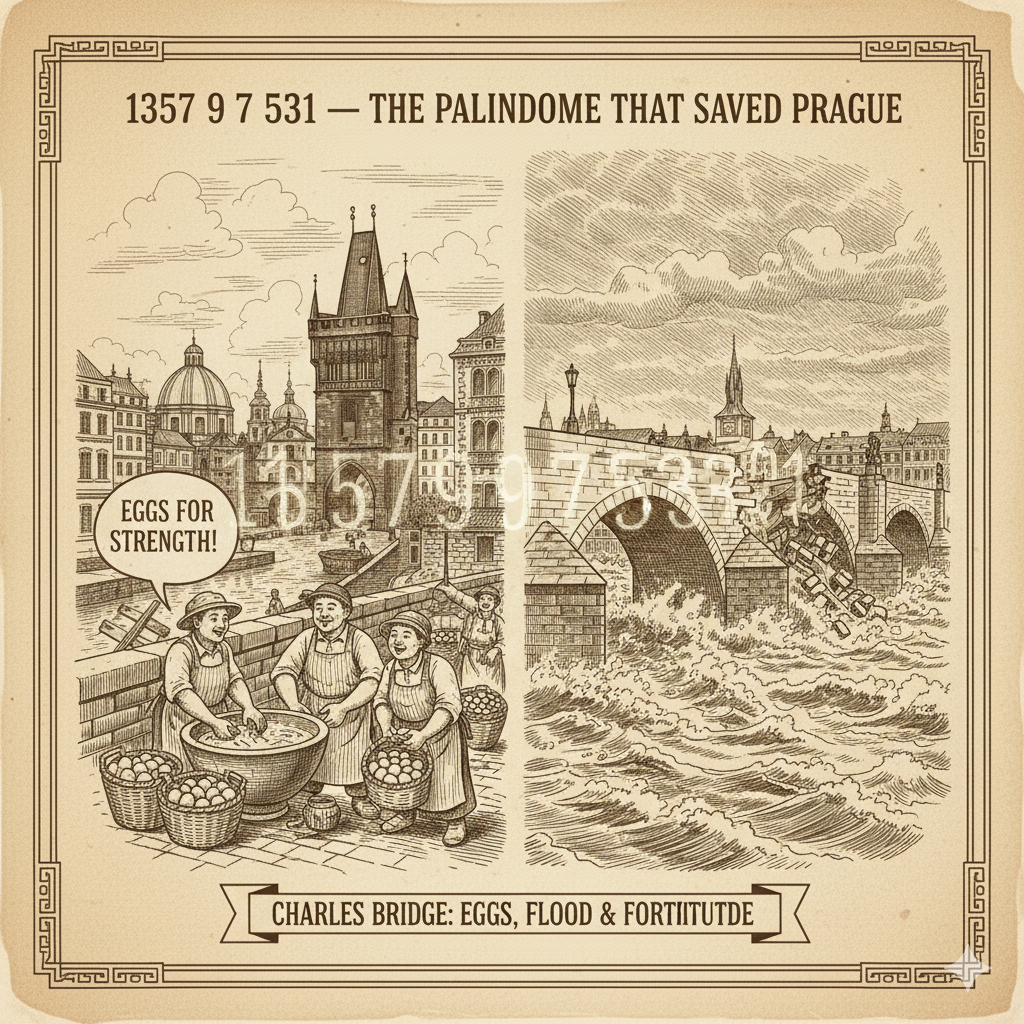
The Moment the Bridge Was Born: 1357 9 7 531
On 9 July 1357, at precisely 5:31 a.m., Charles IV laid the foundation stone.
Not randomly.
He believed in astrology, geometry, and the symbolism of numbers.
His chosen time formed a perfect palindrome:
1 3 5 7 9 7 5 3 1
A sequence rising to the center, then descending back —
an equation of balance
mirroring the symmetry of an arch.
Some call it superstition.
But the bridge’s survival makes it feel like prophecy.

The Stone That Remembered
The bridge is built of Bohemian sandstone, cut and carried from quarries miles away.
But the true magic lies in what held the stones together.
According to tradition, the mortar included:
- water from the river
- local lime
- and… egg yolks.
Why egg yolks?
Because egg proteins strengthen adhesion, reduce cracking, and increase long-term durability —
a polymer solution centuries before polymer science existed.
Villages across Bohemia were ordered to send eggs to Prague.
Wagons arrived filled with baskets wrapped in straw…
but the legends say not everyone understood the assignment.
Some villages — fearing their eggs would break on the journey —
sent cheese instead, believing it was “just another dairy product,”
while others arrived proudly with hard-boiled eggs,
unknowingly ruining the ingredient that made the mortar strong.
The Romans used pozzolans.
The Czechs used yolks.
Civil engineering has always been a combination of intuition and innovation.
Three Arches, One Philosophy
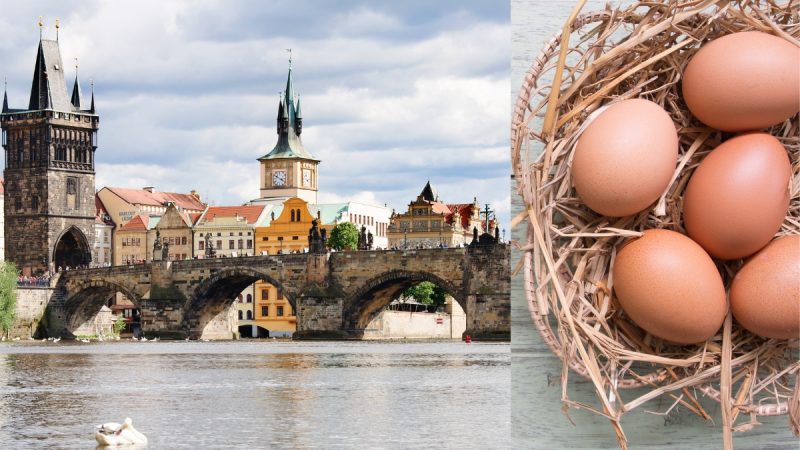
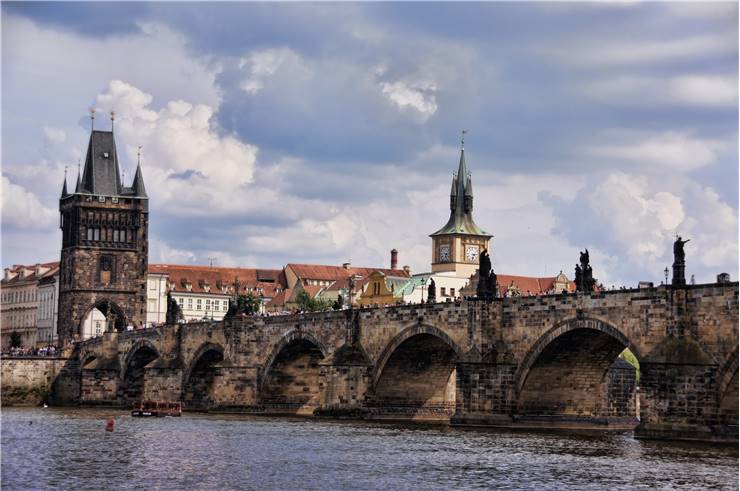
Charles Bridge spans the river with 16 arches,
each one a perfect exercise in Roman compression geometry.
- Wide, low arches were chosen to spread load gently into the piers.
- Each arch supports the next — a chain of thrust lines dancing across the river.
- The flatter profile reduces uplift and improves stability under floods.
This wasn’t just architecture.
It was force choreography.
Even today, the arch geometry fits within modern structural safety criteria.
The medieval masons got it right because they understood their material —
stone is strongest when it pushes
and weakest when it pulls.
So they designed a system where the stone never needed to pull.
The Foundations That Learned to Breathe
The Vltava was too wild to be forced into submission.
So the engineers worked with the river, not against it.
They drove timber piles deep into the riverbed —
not for strength alone, but to absorb vibration and scour.
Wood underwater lasts centuries.
Wood that supports stone lasts even longer.
On top of the piles, they built massive piers shaped like ship prows.
These “cutwaters” split and redirect flow,
reducing the destructive force of ice and floodwaters.
Most medieval bridges lacked this subtlety.
Charles Bridge survived because its engineers understood hydraulics
long before the word existed.
The Flood of 1890 — The Bridge’s Hardest Exam
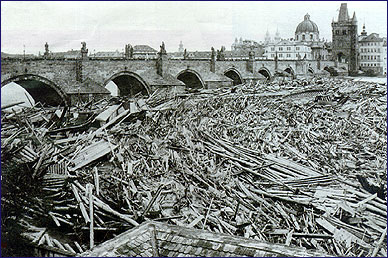
On 4 September 1890, a catastrophic flood struck Prague.
Water levels rose.
Trees became battering rams.
Ice and debris slammed into the piers like artillery.
Three arches collapsed.
Dozens of statues fell.
Two pillars were torn open.
But the bridge did not fall.
Why?
Because the designers built redundancy into every piece:
- Interlocking sandstone blocks
- Arches that redirect load around missing segments
- Massive self-weight that stabilizes through inertia
- Wide piers that hold even when damaged
Modern engineers analyzed the damage and concluded:
“The medieval builders overdesigned their bridge with instinctive genius.”
It was engineered to survive what it could not predict.

The Bridge That Became a Fortress
Most bridges connect places.
This one connected eras.
Charles Bridge was built wide — intentionally — to move armies.
Its towers served as defensive gates.
Its parapets allowed archers to fire.
Its position controlled the trade of a kingdom.
It was not only an engineering achievement —
it was infrastructure as power.
When an empire needed strength, it built it in stone.
A Bridge of Stories, a Story of Structure
Today, tourists see statues — saints in baroque poses, stories carved in silhouette.
But beneath that art lies the cold logic of material science:
- geometry that tames load
- foundations that negotiate with water
- mortar that heals itself
- arches that redistribute stress
- piers shaped by fluid mechanics
- and a timeline set by numerology
Charles Bridge is the rare structure where myth and mechanics occupy the same footprint.
At Kousain, we see Charles Bridge as more than history.
It is a lesson.
A reminder.
A challenge.
To build structures that do not merely stand —
but endure.
To let geometry carry weight,
to let materials breathe,
to design for threats centuries away,
to create harmony between nature and form.
Because the true measure of a structure
is not how it rises —
but how long it remains.