A Dam So Big, It Slowed the Earth
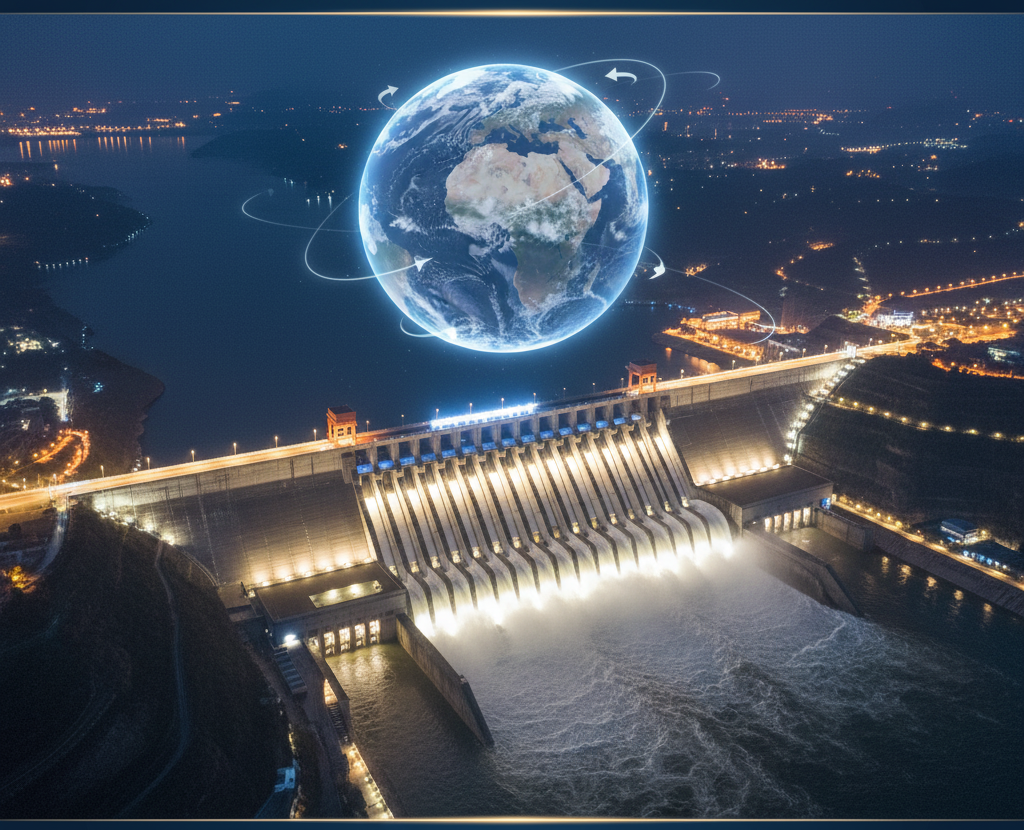
When the Three Gorges Dam in China reached full capacity, scientists noticed something extraordinary — the Earth’s rotation slowed down.
Not by much, of course — just 0.06 milliseconds — but enough for NASA to confirm that the redistribution of billions of tons of water had shifted the planet’s moment of inertia, making our planet spin ever so slightly slower.
It sounds like science fiction: an engineering project that literally changed time.
But this was not imagination — it was physics meeting ambition on a colossal scale.
The Scale That Redefined “Massive”
Stretching 2.3 kilometers across the Yangtze River, the Three Gorges Dam is the largest hydroelectric power station on Earth.
It stands 185 meters tall, creates a reservoir 600 kilometers long, and holds over 39 trillion kilograms of water at full capacity.
To engineers, those numbers are dizzying.
To geophysicists, they’re transformative.
When so much mass is lifted higher above the Earth’s center — as when a skater extends their arms — the planet’s rotation slows slightly. The same conservation-of-angular-momentum principle that governs a spinning top applies to Earth itself.
It’s a poetic reminder that even the smallest fraction of a millisecond carries the weight of human engineering.
The Engineering Challenge of Containing a River That Shaped China
Before the dam, the Yangtze was both a giver of life and a bringer of death.
For centuries, its floods devastated cities and farmland. The dream of taming it went back to ancient dynasties — but it was only at the turn of the millennium that technology caught up with imagination.
Building the dam meant confronting challenges on every scale:
- Unprecedented Hydrodynamic Forces: The pressure at the base exceeds 100 meters of head, demanding concrete with exceptional compressive strength and meticulous thermal control during curing to prevent cracking.
- Sedimentation and Scour: Engineers had to model how silt would accumulate and how flow velocities could be managed to avoid erosion near the spillways.
- Navigation Locks: Massive ship locks, each large enough for a 10,000-ton vessel, were designed to lift and lower ships through a 113-meter vertical difference.
- Seismic Safety: The region lies near fault lines, forcing designers to ensure the dam could withstand earthquakes up to magnitude 7 on the Richter scale.
The dam’s construction required over 27 million cubic meters of concrete, and planners had to model thermal gradients, water uplift pressures, and dynamic loads — all while maintaining continuous river traffic.
It was a lesson in balancing ambition with precision: a structure that not only blocks a river but also dances with its immense energy.
When the World Tilted — The Science of Slowing Time
NASA’s calculation was simple yet profound.
By holding such an enormous mass of water at a higher elevation, the Three Gorges Dam slightly increased Earth’s moment of inertia — the same property that determines how resistant a body is to changes in its rotation.
The effect is tiny, but measurable:
- Earth’s day lengthened by about 0.06 milliseconds.
- The poles shifted by roughly 2 centimeters.
For perspective, that’s less than a blink in cosmic terms — but it means a dam built by humans left a measurable mark on planetary dynamics.
And it’s not just the Three Gorges Dam.
Large earthquakes, melting glaciers, and other massive redistributions of mass all tweak Earth’s rotation. But this was unique — a human-made structure doing what only tectonics or ice ages usually could.
Unintended Consequences and Unseen Forces
Such scale brings both power and controversy.
Engineers and environmentalists alike have debated the dam’s ripple effects:
- Reservoir-Induced Seismicity: Filling the reservoir altered subsurface stress fields, and minor tremors were recorded nearby.
- Ecological Disruption: Fish migration routes and sediment flow patterns changed drastically, reshaping ecosystems downstream.
- Cultural and Social Shifts: Over 1.3 million people were relocated as ancient towns and archaeological sites disappeared beneath the rising water.
To build something that moves mountains — literally and figuratively — is both an achievement and a reckoning.
A Lesson in Scale — and in Humility
The Three Gorges Dam stands as a monument to human capability — the will to shape nature through calculation, courage, and concrete.
Yet it’s also a humbling reminder: every structure exists within a larger structure — our planet itself.
In every meter of reinforced concrete lies an echo of the delicate balance between civilization and the Earth it rests upon.
When engineers talk about “load paths,” “stress distribution,” or “hydraulic head,” the Three Gorges Dam is not just an example — it’s a symbol of how far we’ve come, and how carefully we must tread when our creations can shift the rhythm of the planet.
In Reflection — From the Yangtze to the Cosmos
When future generations study the 21st century’s engineering marvels, the Three Gorges Dam will stand as both wonder and warning — proof that our equations can reach into the very fabric of Earth’s motion.
And as we continue to design, build, and dream, let’s remember that our greatest works don’t just stand on Earth — they move it.
Built with vision, precision, and the audacity to shift time itself — a story that continues to inspire us at Kousain Engineering.