When the Earth Whispered Back
Every engineer on the Panama Canal remembers the first time the Culebra mountain answered them.
Not with noise.
Not with violence.
But with a kind of movement that didn’t belong to soil.
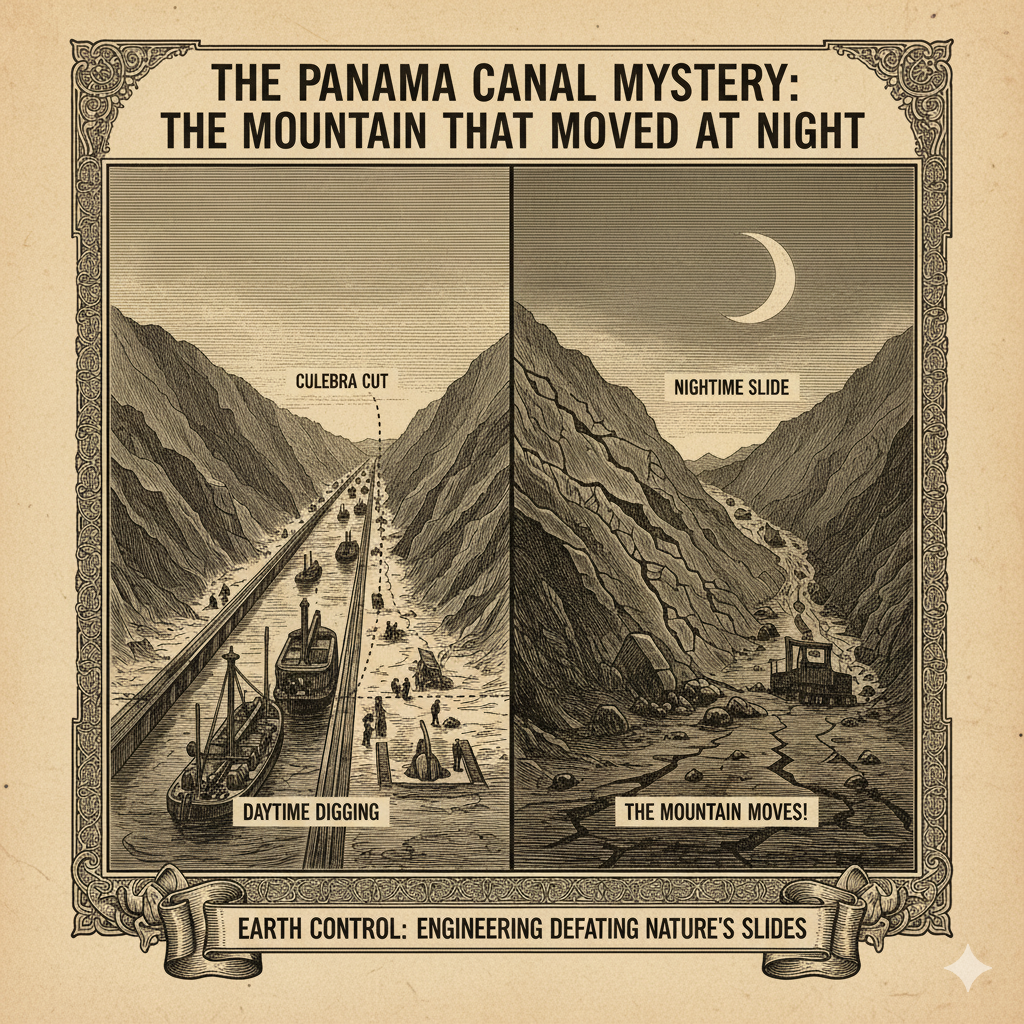
One morning in 1907, a worker walked to the edge of the excavation pit—
and froze.
The valley floor, where men had dug for months,
was no longer there.
In the night, the mountain had slid inward, smooth and silent,
as if a giant hand had pulled the earth back into place.
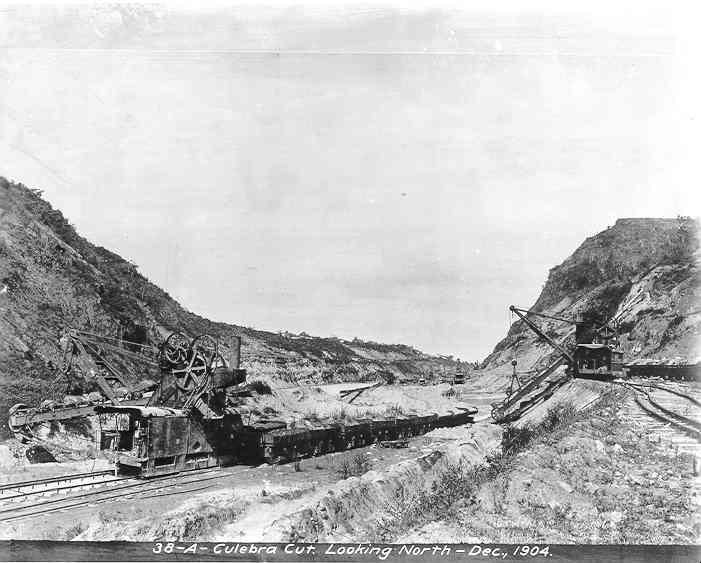
Rail tracks twisted like curled tongues.
Iron shovels, seventy tons each, stuck out from the mud at angles no machine could make.
The cut—once a perfect V—had become a bruise.
The mountain had erased their progress.
Not with a landslide.
But with intent.
The Engineers Who Didn’t Realize They Were Being Studied
At first, the engineers believed the disaster was mechanical:
- A single slope collapse
- A bad patch of soil
- A freak accident
But the next week it happened again.
And again.
And again.
Earth does not repeat accidents.
It repeats patterns.
That’s when suspicion began to grow in the camp:
“This place isn’t failing.
This place is responding.”
When workers removed 500,000 cubic meters of earth?
The mountain returned 600,000.
When they cut steeper walls to “speed up the job”?
The walls slid lower.
When they dug fast?
The mountain moved faster.
It was as if the ridge understood what engineers wanted—
and chose the opposite.
The Slide That Seemed to Wake Up the Valley
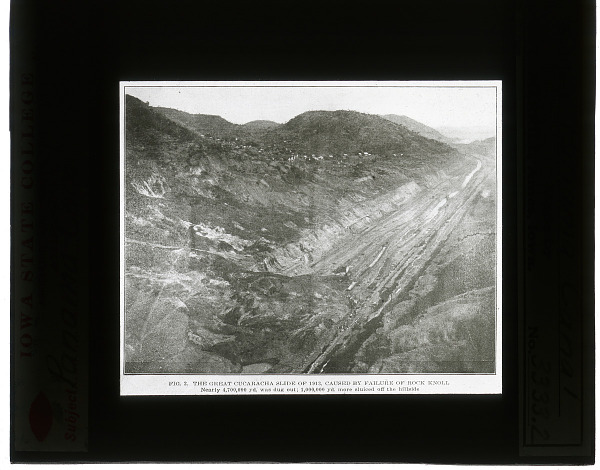
The worst came in 1915.
The Cucaracha Slide.
It began with a tremor so faint workers thought it was thunder far away.
But the animals reacted first—dogs ran, birds fled the valley.
Then the ground exhaled.
The entire hillside—forty acres of it—
did not fall.
It glided,
slow, deliberate, horrifyingly smooth.
Men watched trees drift sideways.
Rail tracks bowed as if someone pressed a finger into soft wax.
A locomotive began tilting and kept tilting until it vanished under brown earth.
Steam shovels disappeared with no crash,
no sound,
just swallowed—
like something below had opened its mouth.
An American foreman whispered:
“It’s not a slide.
It’s a creature.”
And for the first time, the engineers believed him.
The Strange Clues the Mountain Began to Leave
The valley didn’t just move.
It communicated.
Clues appeared everywhere:
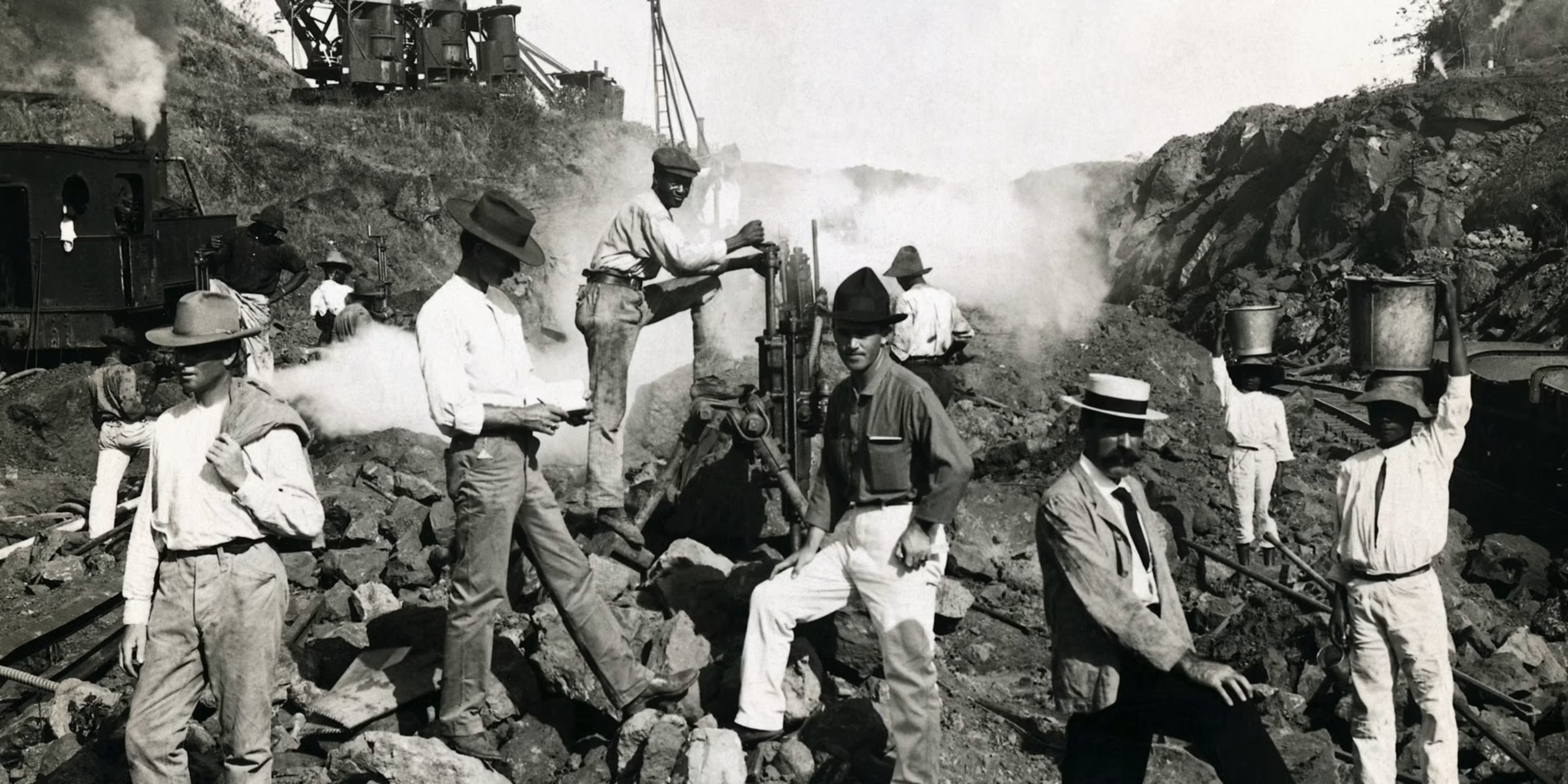
- Fresh cracks near the crest every time engineers dug too deep.
- Springs of water bubbling from new places, as if the mountain was sweating.
- Trees tilting in the same direction days before a slide.
- A rhythmic groaning at night, like breath beneath the soil.
Engineers began marking the cracks with numbered stakes.
Each morning, they returned.
Each morning, the numbers had shifted—
some moved inches, some feet.
No one knew the words “pore pressure” or “effective stress.”
But they could feel a truth older than theory:
The mountain was alive in its own way.
And it was learning.
The Moment an Engineer Finally Asked the Right Question
One afternoon, Colonel David Gaillard stood at the bottom of the cut.
He was exhausted—
the mountain had undone nearly a year of his work.
He knelt.
Picked up a handful of the wet clay.
Rolled it between his fingers.
Then he said the sentence that changed the Panama Canal forever:
“It isn’t failing because we’re cutting it.
It’s failing because we’re cutting it wrong.”
A whisper of understanding swept through the engineering corps.
The mountain wasn’t angry.
It was reacting to:
- too much weight removed too quickly
- slopes too steep
- water trapped within
- layers that didn’t want to stand exposed
The engineers had been treating the mountain like stone.
But it behaved like water—
slow water, trapped in a solid body.
And water always seeks equilibrium.
The Day Engineers Finally Listened—and the Mountain Relented
For the first time,
engineers changed their approach.
Not out of triumph.
Out of respect.
They carved gentle benches instead of vertical cuts—
steps that calmed the mountain’s desire to slide.
They added drainage channels,
and the ground dried like skin after fever.
They spaced the heavy machines far apart,
reducing the weight that triggered movement.
They dug slower,
allowing the earth to settle between cuts.
The mountain moved less.
Then it moved even less.
And slowly…
very slowly…
It allowed itself to be carved.
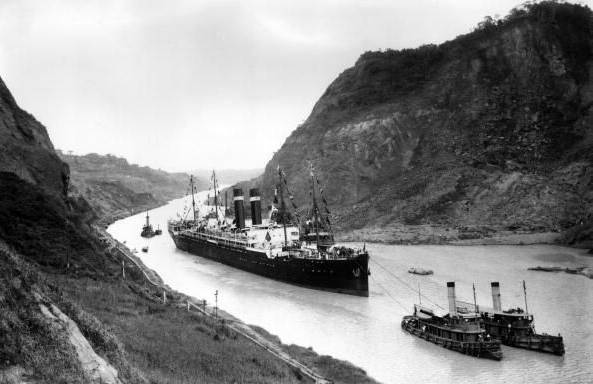
When the first water flowed through the finished cut,
workers said it felt less like victory—
and more like permission
What the Mountain Really Taught Engineers
Before Panama, soil was “dirt.”
After Panama, engineers knew soil was:
- a memory
- a behavior
- a response
- a living pattern
They discovered—without equations—
every principle that would later define geotechnical science:
- slopes fail not suddenly, but progressively
- water is the invisible enemy
- earth flows when relieved of pressure
- drainage is a form of diplomacy
- and every mountain has its own personality
The mountain at Culebra wasn’t a villain.
It was a teacher,
revealing its knowledge only when challenged.

At Kousain, We are Students of Earth
Every engineer who digs into a hillside,
every geotech who reads a borehole log,
every designer who respects water pressure—
They are students of the same mountain.
The canal wasn’t carved through a mountain.
It was carved through a mystery that revealed itself one slide at a time.
And that is the true beauty behind the Panama Canal.