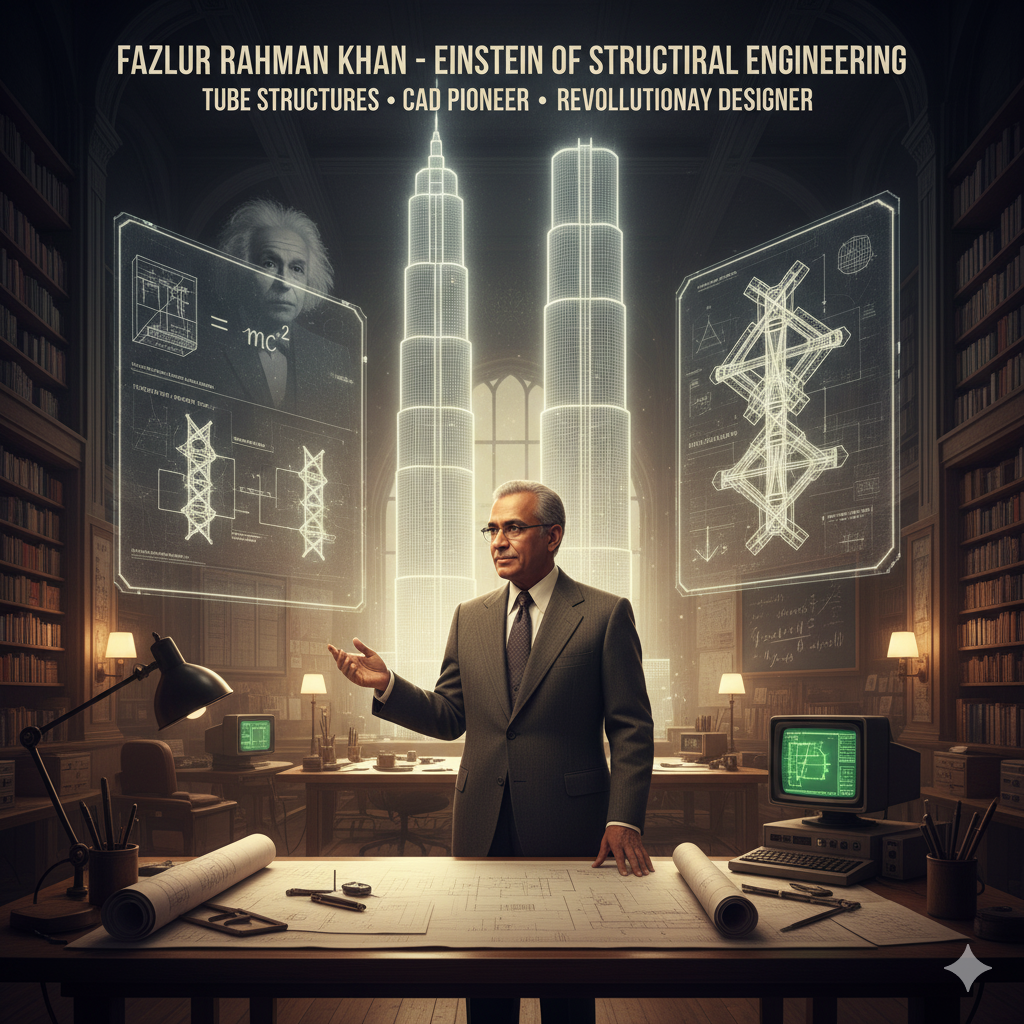
The Mind That Reshaped Skylines
In the pantheon of great engineers, few names shine brighter than Dr. Fazlur Rahman Khan — the Bangladeshi-American visionary often hailed as “The Einstein of Structural Engineering.”
At a time when the limits of height seemed absolute, Khan looked at the rigid, inefficient steel frames of the mid-20th century and quietly asked, “What if buildings could behave like hollow tubes — strong, simple, and elegant?”
That single question didn’t just challenge convention — it reshaped the skyline of the world.
From Dhaka to Chicago — A Journey of Genius
Born in 1929 in Dhaka (then part of British India, now Bangladesh), Khan grew up fascinated by mathematics and the unseen mechanics of the world.
After earning his civil engineering degree from the University of Dhaka, he went on to complete his Ph.D. at the University of Illinois at Urbana-Champaign — where his intellect caught fire.
Soon after joining Skidmore, Owings & Merrill (SOM) in Chicago, Khan found himself standing before a question that had puzzled engineers for decades:
How can we make skyscrapers taller without making them uneconomically heavy?
His answer came not from brute force, but from structural simplicity.
The Tube Revolution — Rethinking the Skeleton of the Sky
Before Khan, tall buildings were built like vertical stacks of beams and columns — “ladders” reaching upward. As buildings grew taller, these frames became inefficient: too much steel, too little stability.
Khan’s breakthrough was the tubular system — a revolutionary idea that treated the building as a hollow cylinder resisting lateral loads as a whole.
Instead of relying on an inner grid, the exterior walls became the structure — stiff frames of closely spaced columns and deep spandrel beams forming a rigid tube.
The wind, instead of fighting countless internal columns, now pressed against a single, unified shell.
This system could resist wind and seismic forces with remarkable efficiency — using up to 40% less steel than traditional designs.
Khan didn’t just design taller buildings; he invented a new structural language.
Types of Tube Systems Invented by Khan
- Framed Tube System – Used in buildings like the DeWitt-Chestnut Apartments (now Plaza on DeWitt). First practical implementation of the tube concept — a revolution in simplicity.
- Trussed Tube (or X-Braced Tube) – Introduced in the John Hancock Center (1969). The iconic X-braces on the façade aren’t just aesthetic; they’re the structure itself. The building behaves as a single tube, braced against the wind.
- Bundled Tube System – Perfected in the Willis (formerly Sears) Tower (1973). Instead of one big tube, nine tubes are bundled together, each sharing load paths — allowing unprecedented height and stability.
Khan’s bundled tube design made it possible to build supertall structures economically — the foundation of today’s megatall skyscrapers like Burj Khalifa and One World Trade Center.

Beyond Skyscrapers — Khan’s Versatile Genius
Though best known for skyscrapers, Khan’s portfolio spanned far beyond.
He believed engineering was a universal language — whether for bridges, terminals, or tunnels — and that the same principles of efficiency applied everywhere.
1. Jeddah Hajj Terminal, Saudi Arabia
Khan’s design philosophy influenced the Hajj Terminal at King Abdulaziz International Airport (completed 1981).
The structure’s modular tensile fabric roof — inspired by Bedouin tents — provides natural ventilation and vast unobstructed spaces for thousands of pilgrims.
It remains a pioneering example of lightweight structural design and environmental harmony.

2. Bridges, Railways, Ships, and Tunnels
Khan’s structural logic extended seamlessly across disciplines:
- Bridges: His understanding of load paths and lateral stability influenced long-span steel and concrete bridge design, emphasizing stiffness through geometry rather than mass.
- Railway and Tunnel Design: He applied tube-like concepts underground — seeing tunnels as compression shells resisting lateral earth pressure like vertical tubes resist wind.
- Ships: Khan studied hull stresses and fluid-structure interactions, seeing ships as floating beams — a natural cousin of the tubular skyscraper.
Khan’s brilliance was not in the structures themselves, but in the thinking behind them:
Everything — a bridge, a ship, a tunnel — is a dialogue between force and form.
The Digital Frontier — Early Work in Computer-Aided Design
Long before CAD became standard, Khan was among the first engineers to integrate computers into structural analysis and design.
He wrote and collaborated on some of the earliest algorithms for matrix stiffness methods, using computers to model tall buildings with unprecedented accuracy.
At SOM, he pioneered the use of digital tools to simulate wind and seismic behavior — making skyscraper design not just artistic, but predictive.
In the 1960s and 70s, when most engineers still relied on hand calculations, Khan was already coding the skyline.
Humanity and Structure — A Legacy Beyond Steel
What made Fazlur Rahman Khan extraordinary wasn’t only his intellect — it was his humility.
He believed that engineers were not just builders, but caretakers of civilization.
“The technical man must not be lost in his own technology,” he once said, “He must be able to appreciate life, and life is art, drama, music, and most importantly, people.”
His designs — from the soaring Hancock to the serene Hajj Terminal — prove that strength and elegance can coexist, that efficiency and emotion can live in the same line of force.
The Man Who Made Cities Vertical
Fazlur Rahman Khan passed away in 1982 at just 52 — but in that short time, he changed architecture forever.
Every time we look up at a modern skyline — from Chicago to Dubai, from Shanghai to Mumbai — we’re looking at Khan’s legacy written in steel and concrete.
He didn’t just design buildings.
He taught them how to stand gracefully.
His genius continues to inspire generations of structural engineers, including us at Kousain Engineering, where we strive to carry forward his philosophy — that great structures are not built from materials, but from ideas.

One comment on ““Einstein of Structural Engineering” – Dr Fazlur Rahman Khan”