I) What remains when blood dries and empires fall?
Rome is nearly 2,800 years old.
The likes of Romulus, Augustus, Julius Caesar, Trajan, Hadrian, Marcus Aurelius, and Constantine all have set foot on Roman soil.
At its peak (early 2nd century AD), the Roman Empire’s boundaries extended continents, stretching from Britain (Hadrian’s Wall) and the Rhine/Danube rivers in Europe, across North Africa, through the Middle East to the Euphrates, and incorporating Egypt and the Red Sea, all encircling the Mediterranean Sea, a vast territory secured by frontier systems known as the Limes.
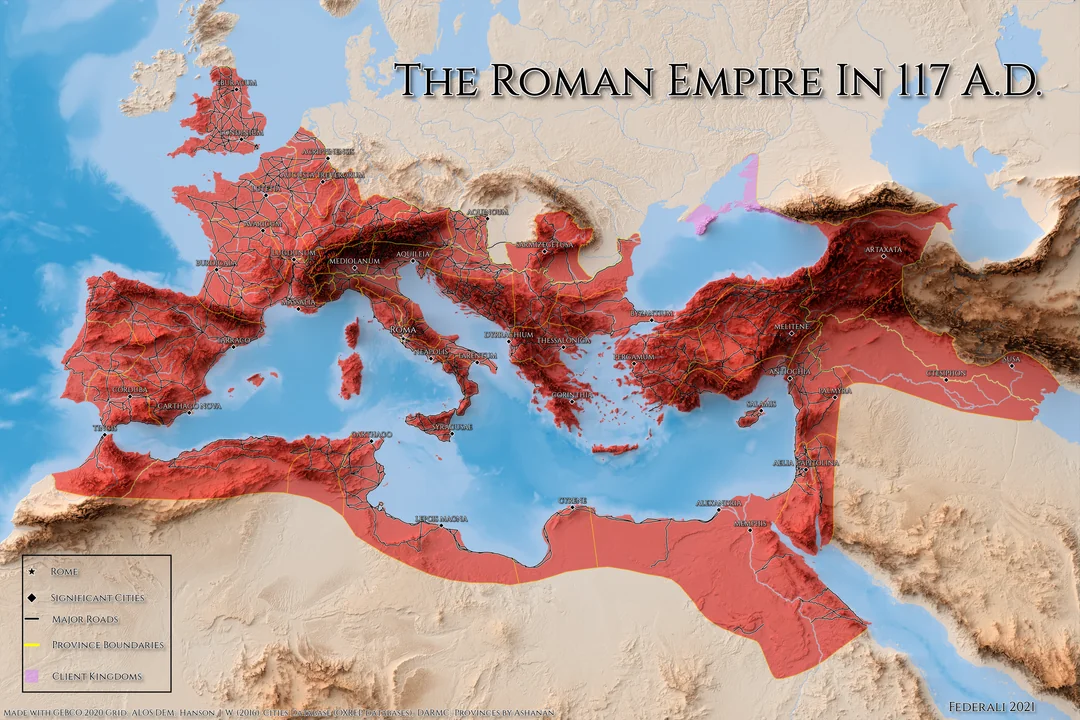
As the ages passed, the tides of war caused these vast borders to shrink, eventually collapsing the empire’s reach and leaving its global power to the pages of history.
Yet, that legacy lives on today in the streets of modern Rome.
If you visit Rome, the city doesn’t prepare you for the anything specific.
The city distracts you first. Fountains that never stop flowing, streets stacked over centuries, ruins so embedded into daily life that history feels ordinary. When everything is ancient, nothing announces itself.
On December 22, 2025, Junaid and I entered the heart of the capital these legendary rulers once commanded, walking through a city that does not freeze its history, but lets it weather.
II) The Heart of the Rome.
A data visualization study by the Moovel lab team (Benedikt Groß, Raphael Reimann, and Philipp Schmitt) titled “Roads to Rome” literally confirmed the ancient proverb “All roads lead to Rome” in a modern context. Using computational design and open-source mapping data, they created visualizations that showed road networks across Europe converging on the Italian capital.
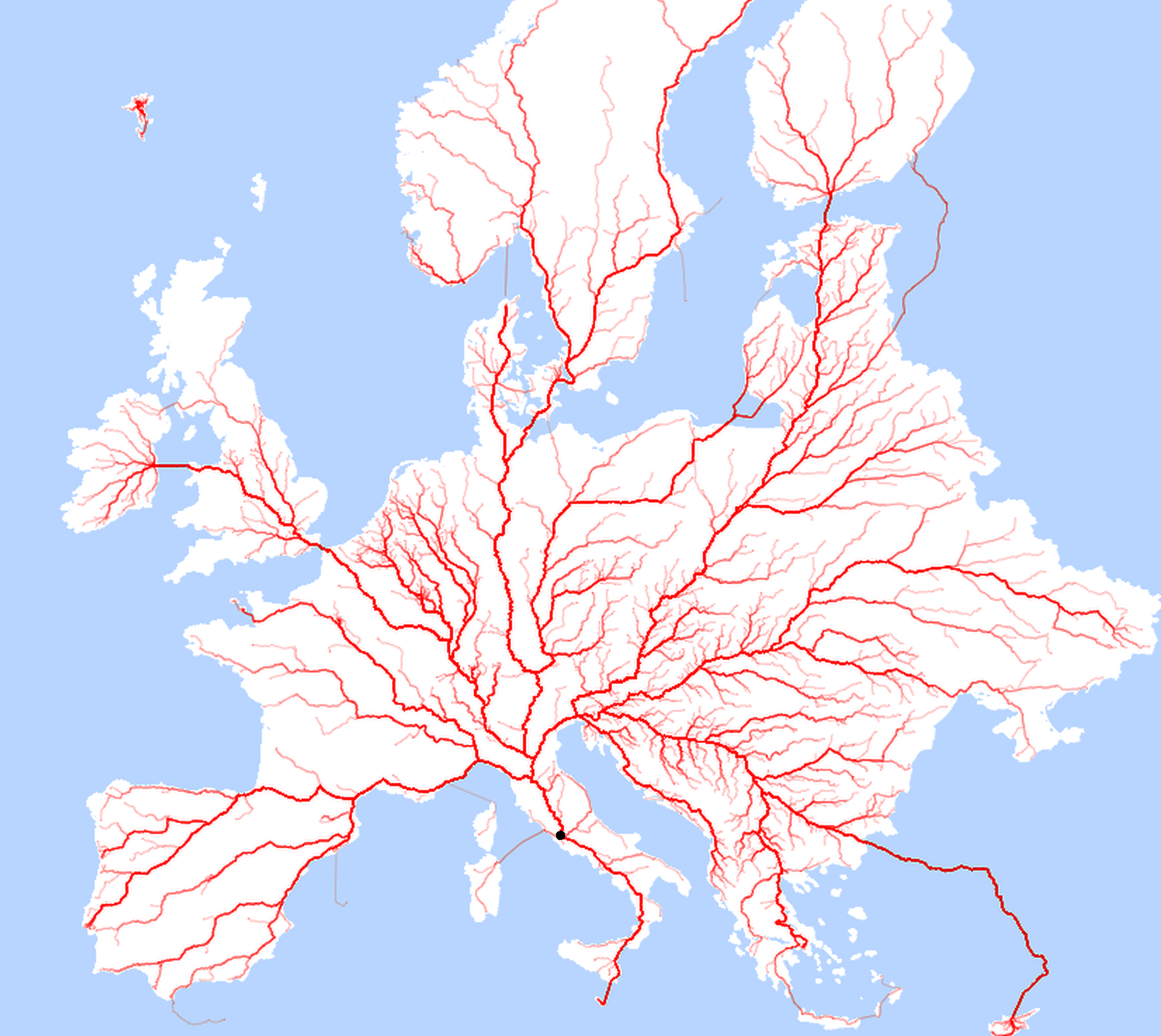
This digital map illustrates how Rome remains the gravitational center of a continent-wide web.
Roads, borders, rivers, and cities still orient themselves toward it, long after the empire that built them disappeared.
Empires may fall.
But the foundations they leave behind continue to guide the world toward their origin.
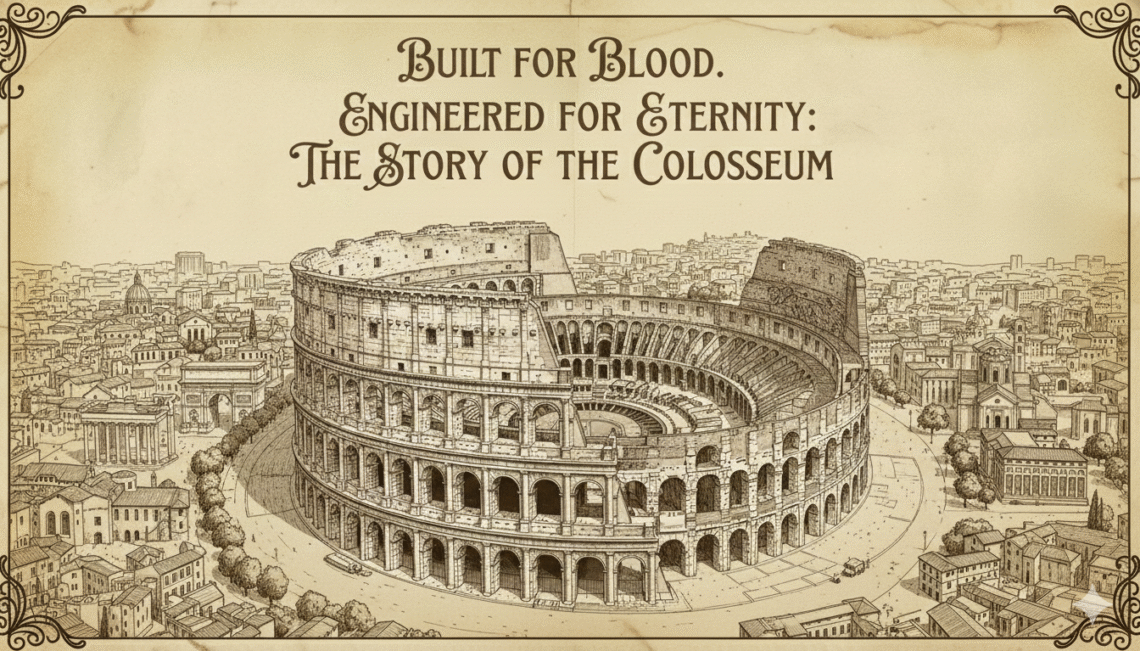
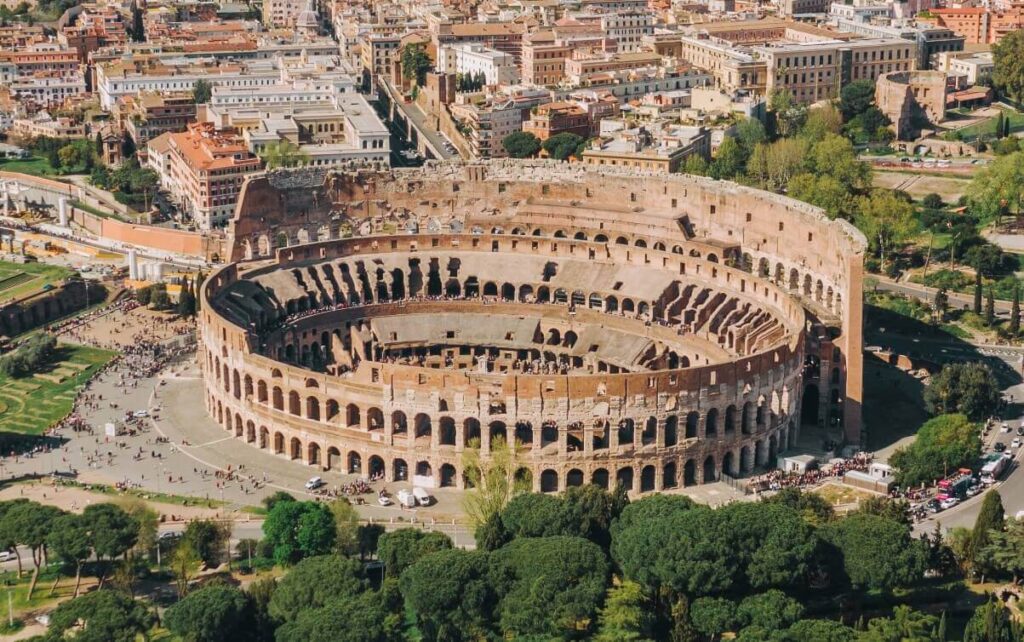
And at the center of that center? Colosseum…
Before it became a ruin, the Colosseum was a statement carved in stone.
It rose in 80 AD, under Emperor Titus, on land that once held Nero’s private lake, a deliberate political reversal. Where one emperor had built indulgence for himself, another replaced it with spectacle for the public.
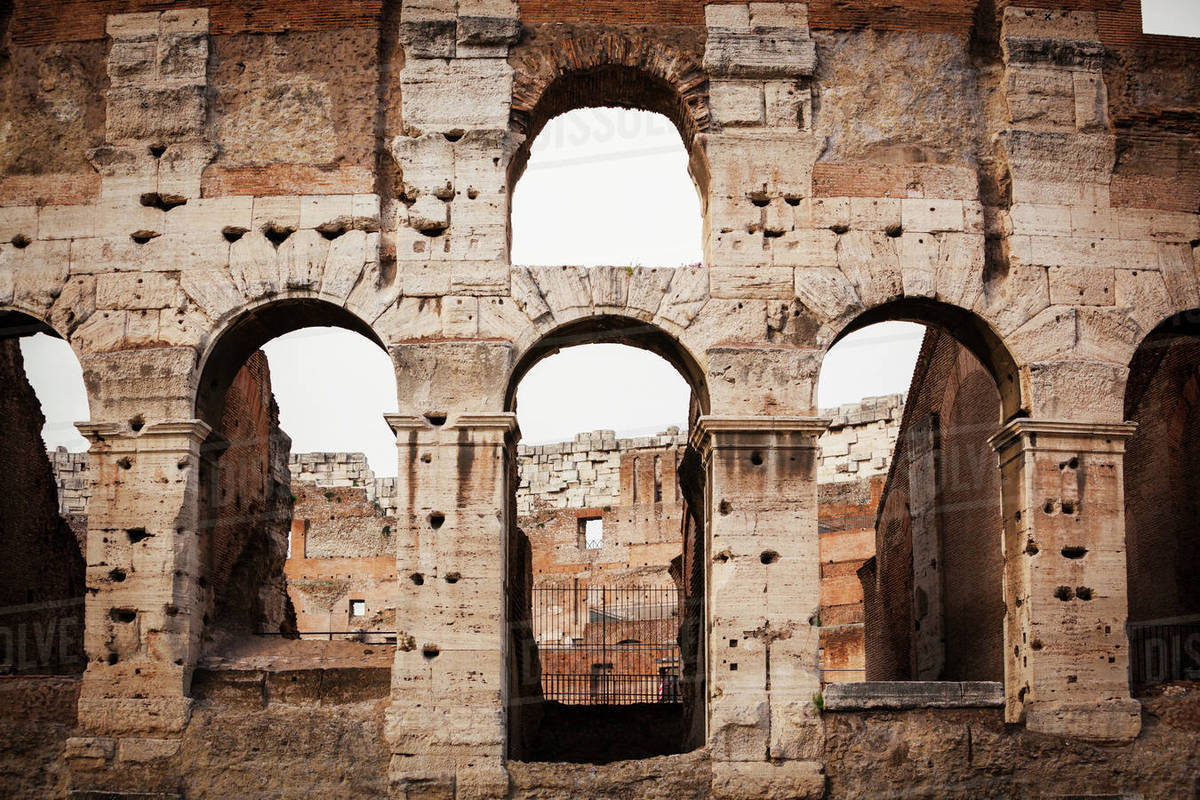
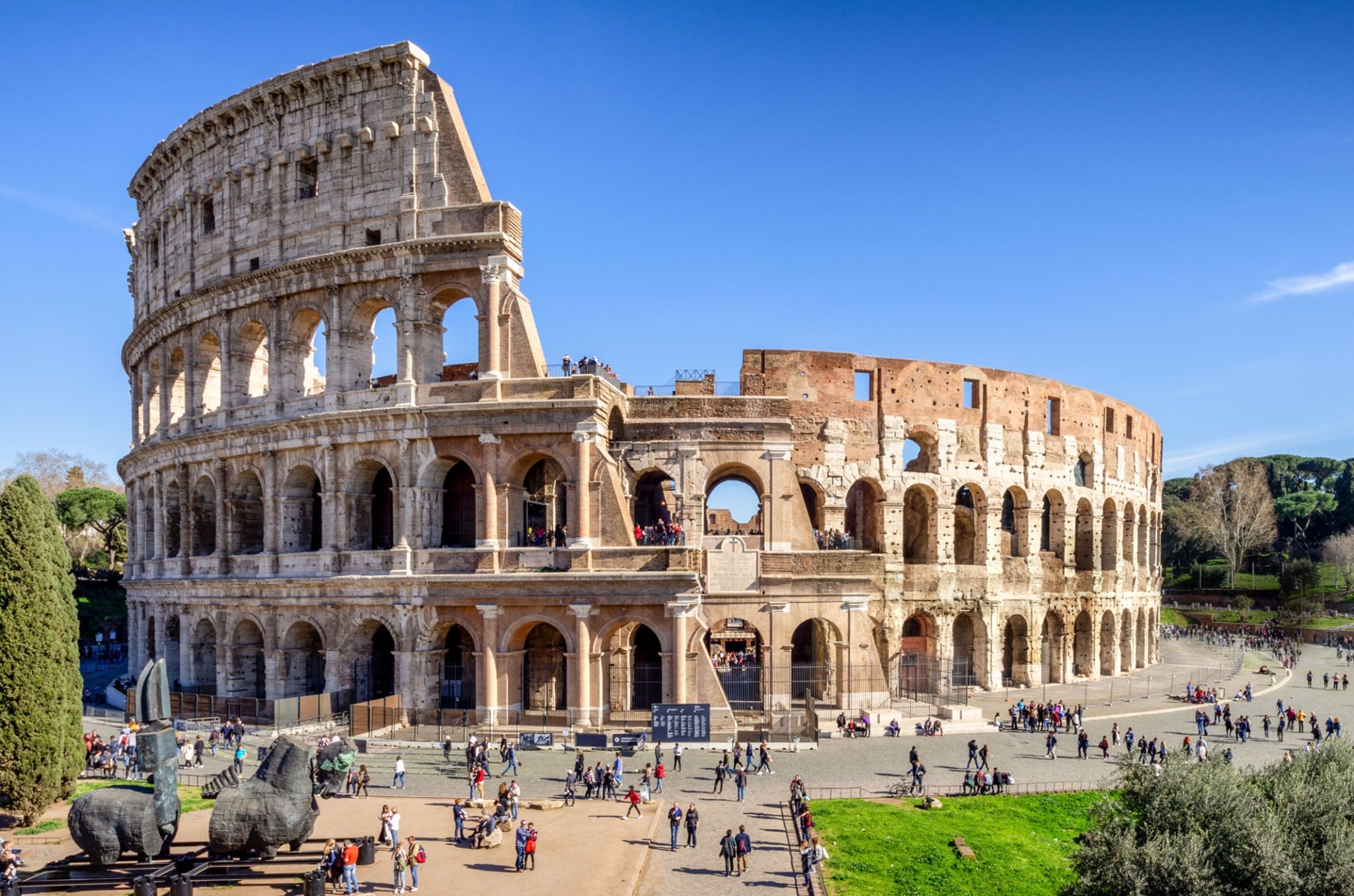
If you look closely at the Colosseum’s exterior, you’ll notice something strange.
The arches feel unfinished.
Once, they weren’t.
Many arches held bronze statues and imperial portraits—faces of emperors watching the crowd enter. But Rome bled gold constantly: wars, expansion, civil conflict. Over centuries, those metal ornaments were removed, melted, and sold.
III) The Shape That Kept the Crowd Alive
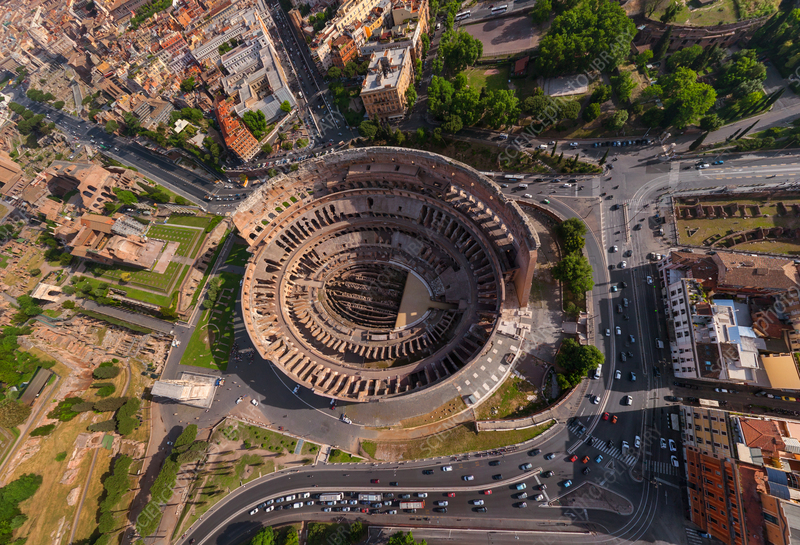
The Colosseum’s elliptical form wasn’t symbolic.
It was necessary.
With a major axis of 189 meters, a minor axis of 156 meters, and space for up to 65,000 people, circulation was a matter of survival.
Riots were common in Roman crowds. Panic was expected.
So the structure was designed to empty in minutes.
- nearly 80 entrances
- radial corridors slicing through the building
- stacked seating tiers directing loads and people downward and outward
This wasn’t kindness.
This was crowd-load engineering, centuries before the term existed.
IV) Beneath the Arena — Where Stone Met Flesh
What most visitors don’t see is what made the Colosseum possible.
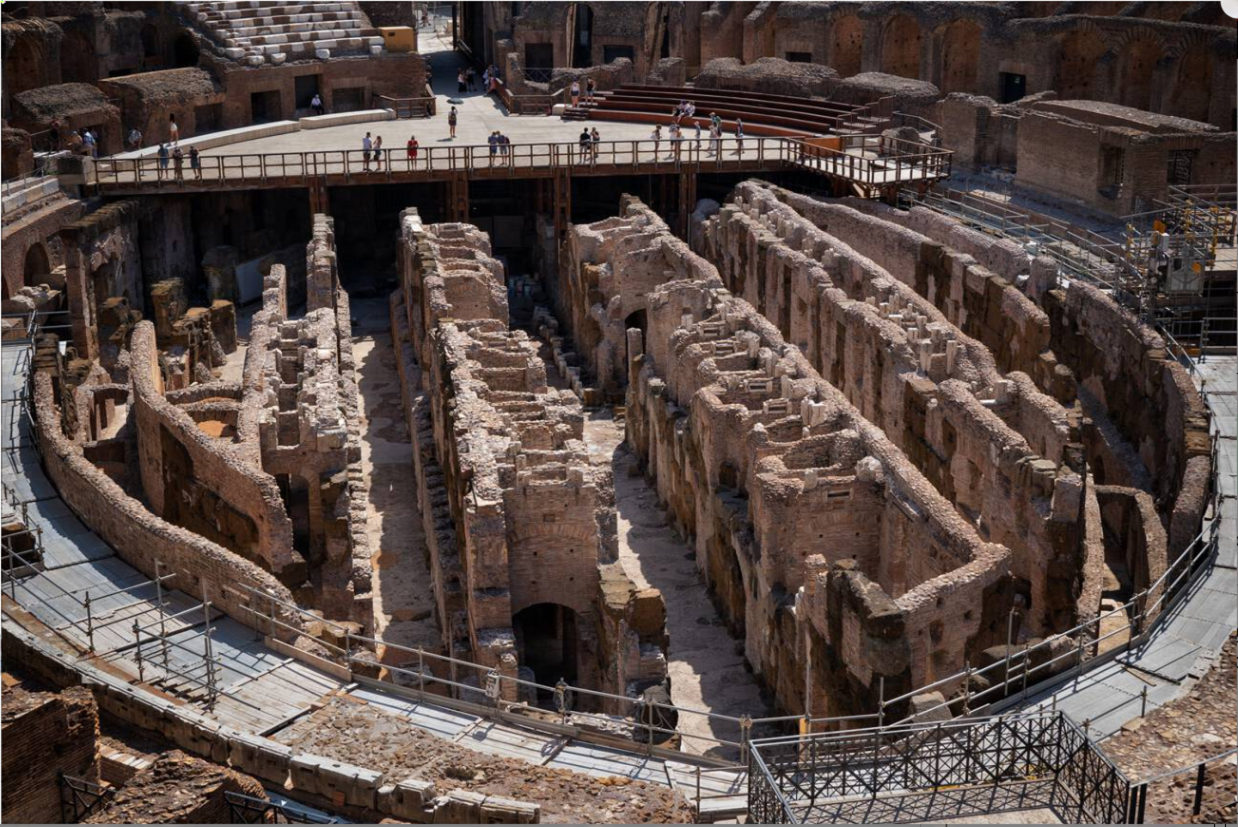
Beneath the wooden arena floor lay the hypogeum — a two-level underground labyrinth of corridors, cages, pulleys, ramps, trapdoors, and elevators.
This was not decorative.
It was a mechanical system.
Gladiators waited in chambers below. Wild animals — lions, leopards, bears — were lifted to the arena through vertical shafts using counterweight-operated platforms. Dozens of trapdoors could open simultaneously.
But here is the structural brilliance:
The hypogeum did not weaken the building.
It was carved and constructed in such a way that the load from 65,000 spectators did not depend on the arena floor.
The spectators sat on a separate radial and concentric system of masonry walls and barrel vaults.
The arena floor was non-structural.
The crowd load flowed outward through:
- radial masonry walls
- annular (ring) corridors
- barrel and groin vaults
- and finally into the perimeter arches
Even when the wooden floor burned or rotted away over centuries,
the structure remained intact.
The spectacle could fail.
The structure would not.
V) Foundations in a Swamp
Here is something rarely mentioned.
The Colosseum was not built on ideal soil.
The site had once been part of Nero’s artificial lake — soft, water-saturated ground.
Before construction began in 72 AD under Emperor Vespasian, the lake was drained. The Romans excavated down and poured massive foundations of Roman concrete (opus caementicium) mixed with volcanic ash from Pozzuoli.
This wasn’t ordinary mortar.
The pozzolanic ash reacted with lime to create a hydraulic cement that strengthened over time — especially in the presence of moisture.
The foundation ring is approximately 13 meters deep in places.
A continuous elliptical concrete ring anchors the entire structure.
Think about that:
65,000 people.
50 meters tall.
Travertine blocks weighing tons each.
All sitting on soil that was once a lake.
And it still stands.
Roman Engineering at its finest.
VI) The Skeleton You Don’t See
The Colosseum is often described as “stone.”
That’s incomplete.
It is a composite system:
- Travertine limestone for the outer load-bearing piers
- Tuff (lighter volcanic stone) for internal radial walls
- Brick-faced concrete for vaults
- Iron clamps (once holding blocks together — later stolen)
Each material was used where it performed best.
Heavy stone for compression.
Lighter materials for secondary loads.
Concrete where geometry demanded flexibility.
This is not ancient brute force.
This is material optimization.
VII) Earthquakes, Theft, and Survival
Rome sits in a seismic region.
Major earthquakes in 847 AD and 1349 AD caused portions of the outer southern ring to collapse.
But notice what failed:
Not the entire building.
Not progressive collapse.
Only sections.
Because the Colosseum was designed as a redundant ring system.
If one part failed, the compression redistributed through adjacent arches.
That is why today you see one side intact and the other partially missing.
The building did not crumble.
It absorbed loss.
VIII) Where the Crowd Stood — And Why It Still Matters
Seating followed strict social hierarchy:
- Emperor and senators at the lowest ring
- Nobility above
- Citizens higher still
- Women and the poor at the top
Their weight was treated as a distributed vertical force, transferred from the seating tiers into the radial walls and annular corridors already described. Whether senator or soldier, each person’s load joined the same compression network and flowed downward into the foundation ring.
Politics organized the crowd.
Engineering carried it.
What this teaches us at Kousain?
The Colosseum was not built to impress a generation.
It was built to outlive one.
Its emperors vanished.
Its marble was stolen.
Its purpose changed.
But its structure remained.
At Kousain, we do not design for tomorrow alone.
We design so that when time strips away ornament,
what remains still stands.
Because legacy is not decoration.
Legacy is structure.