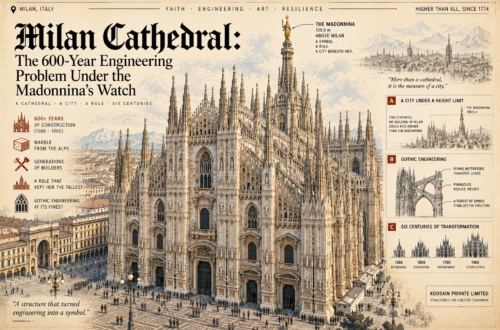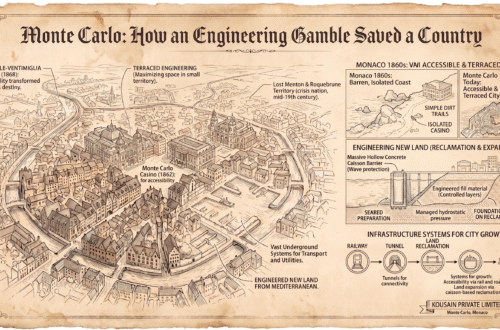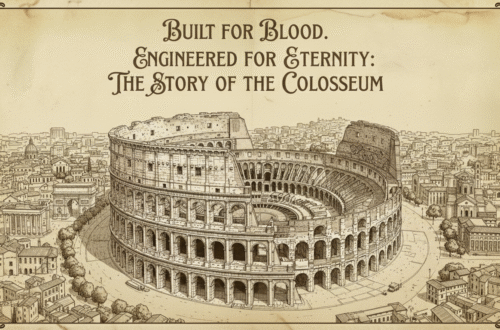
I) The Bridge That Connected Our Cologne Story
In our previous blog, The Stone and the Shell: Cologne’s Two Prayers in Architecture, we explored the breathtaking Gothic engineering of the Cologne Cathedral, a structure that has watched over the city for more than seven centuries.
But before we ever reached the cathedral, there was another structure that quietly stole our attention.
On 27th December 2024, Junaid and I had just finished offering our prayers at the magnificent Cologne Central Mosque. As we made our way towards the cathedral, one structure stood between us and the city’s most famous landmark; a bridge covered with thousands of love locks, alive with the rhythm of passing trains, and carrying nearly everyone entering Cologne’s historic centre.
Like most visitors, we crossed it without giving much thought to the engineering beneath our feet.
It was only later that we discovered this wasn’t just another railway bridge.
It was a bridge that had witnessed war, survived destruction, carried millions of passengers, and quietly demonstrated why the truss remains one of the greatest structural inventions ever conceived.
II) A Bridge Too Important to Lose
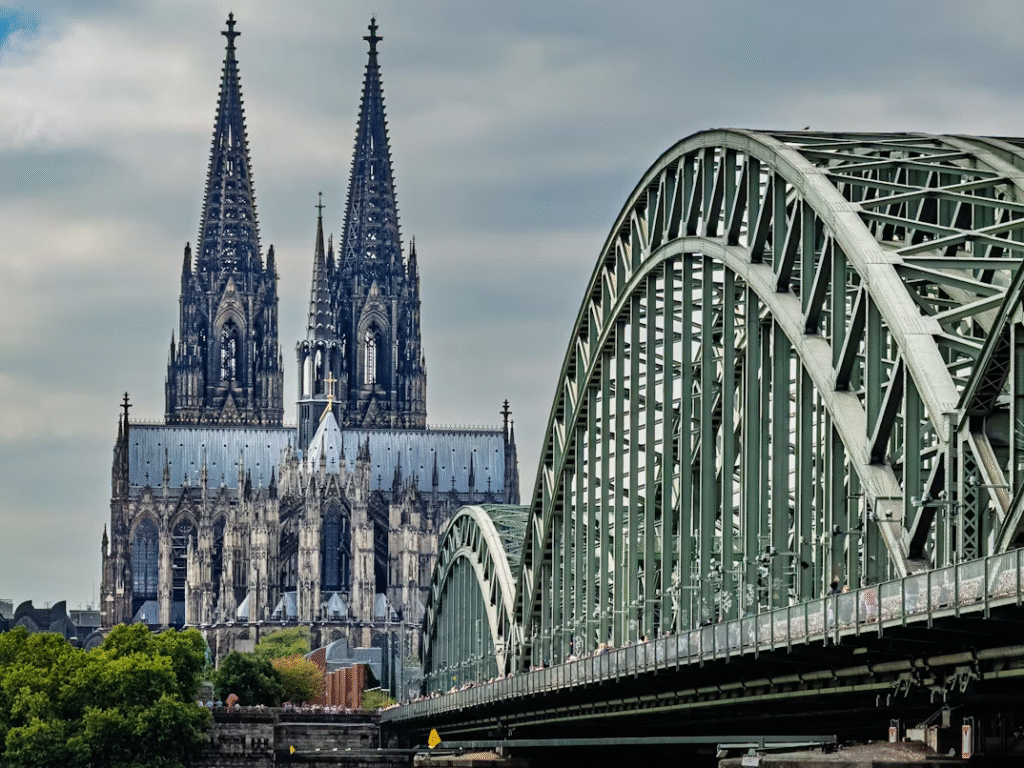
The Hohenzollern Bridge was never just another crossing over the Rhine.
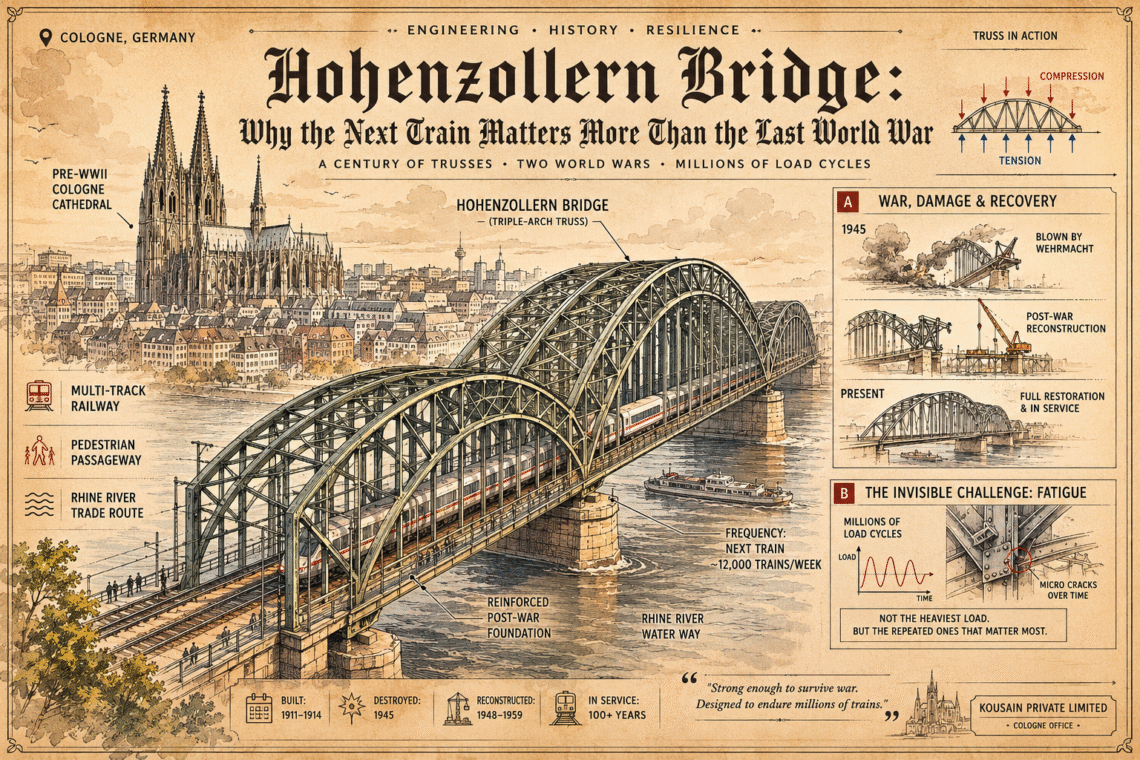
Completed in 1911, the bridge was designed to carry one of Germany’s busiest railway corridors into the heart of Cologne. By the early twentieth century, the Hohenzollern Bridge had become one of Germany’s most important railway links, carrying passenger trains, freight, and military logistics into Cologne’s Central Station. More than a century later, its importance has only grown. Today, over 1,200 trains cross the bridge every single day, making it one of the busiest railway bridges in Europe. Every passing train introduces enormous concentrated wheel loads into its steel trusses, subjecting the structure to millions of load cycles over its lifetime.
This is precisely why engineers chose a truss system.
Unlike solid girders, trusses distribute loads through a network of tension and compression members, allowing long spans to carry extremely heavy railway traffic while using significantly less material. For railway bridges, where stiffness and controlled deflection are just as important as strength, the truss remains one of the most efficient structural forms ever developed.
But that engineering efficiency also gave the bridge strategic importance.
When Allied forces approached the Rhine in 1945, bridges like Hohenzollern became vital military assets. Their ability to carry heavy locomotives also meant they could carry tanks, artillery, and supply convoys.
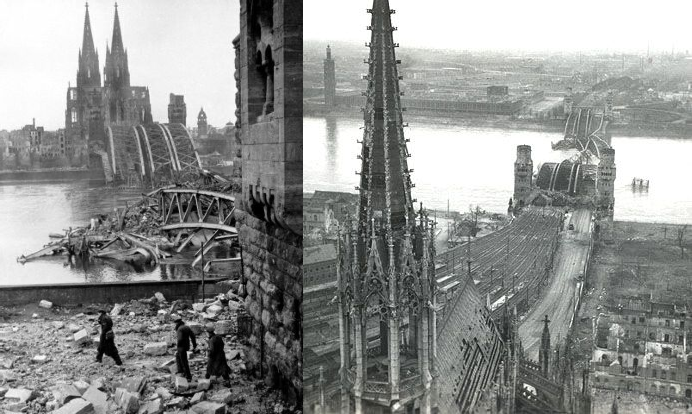
On 6 March 1945, German forces demolished the bridge during their retreat to slow the Allied advance.
The bridge had not failed.
It was deliberately sacrificed because it was structurally too valuable to leave standing.
III) The Beauty of a Triangle
Standing beneath the Hohenzollern Bridge, one detail immediately caught my attention.
It wasn’t the trains.
It wasn’t the river.
It was the endless network of steel triangles stretching across the Rhine.
To most people, they appear repetitive, almost decorative.
To a structural engineer, they reveal exactly how the bridge stands.
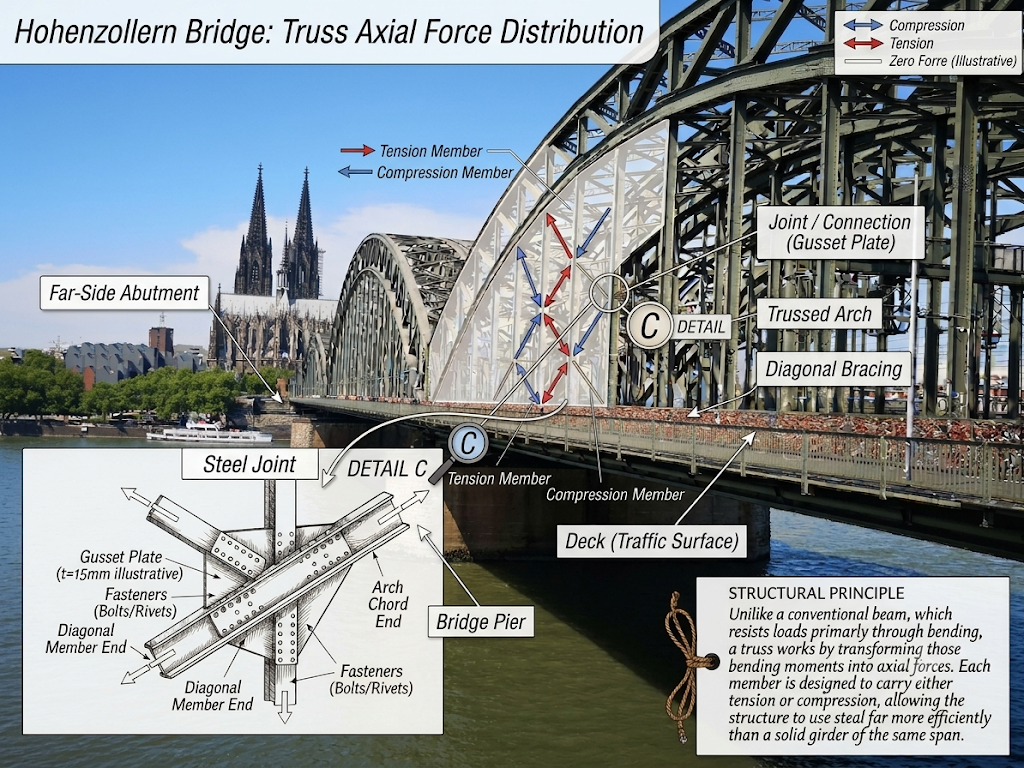
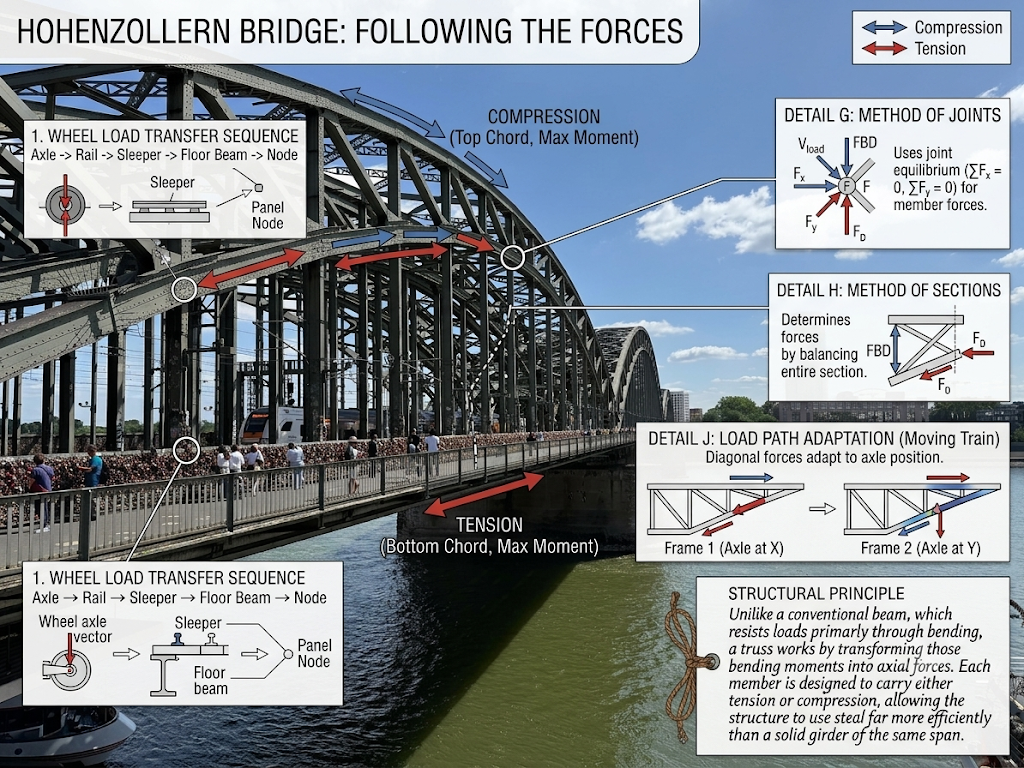
Unlike a conventional beam, which resists loads primarily through bending, a truss works by transforming those bending moments into axial forces. Each member is designed to carry either tension or compression, allowing the structure to use steel far more efficiently than a solid girder of the same span.
But why triangles?
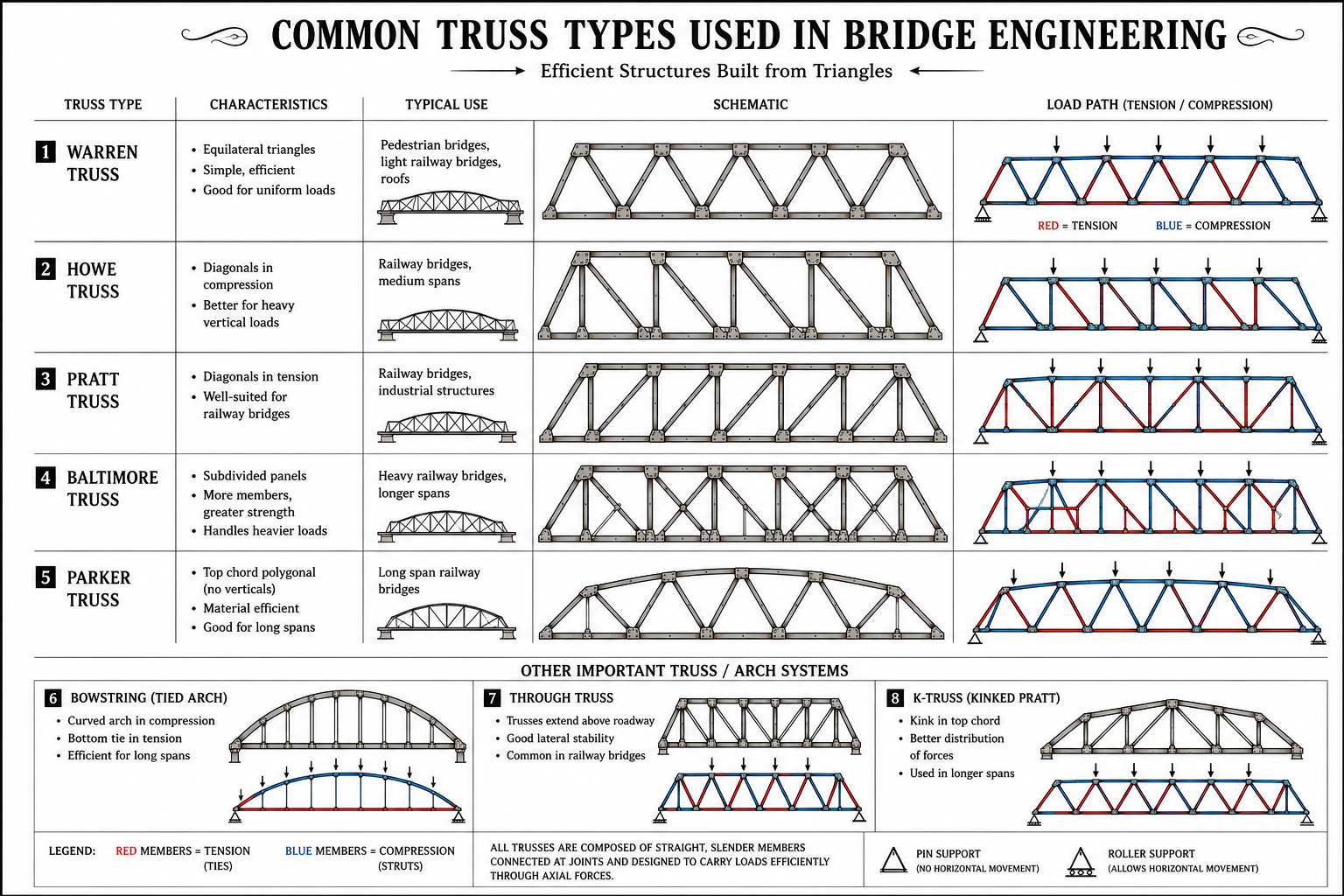
Because they are the simplest geometric shape that cannot change its form without changing the length of one of its sides. A rectangle can easily deform into a parallelogram under lateral forces unless additional bracing is introduced. A triangle, however, remains geometrically stable, making it the fundamental building block of almost every truss ever constructed.
The Hohenzollern Bridge takes this principle one step further.
Unlike a conventional through truss, the bridge’s three main spans are steel tied-arch (bowstring) truss bridges. The graceful steel arches above the railway tracks carry predominantly compressive forces, while the deck below acts as a tension tie, resisting the outward horizontal thrust that would otherwise push the supports apart.
The trussed arch itself is formed from an interconnected network of steel members, allowing forces to be distributed efficiently throughout the structure while maintaining the stiffness required for one of Europe’s busiest railway corridors.
It is an elegant combination of two structural systems.
The arch provides exceptional efficiency in compression.
The truss distributes those forces through lightweight interconnected members.
Together, they create a bridge capable of carrying more than a thousand trains every day while using remarkably little material for its span.
Every diagonal, every vertical, and every chord has a purpose.
There are no unnecessary members.
Every piece of steel participates in carrying the weight of passing trains safely across the Rhine.
And that is precisely what makes trusses so remarkable.
They are not merely collections of steel members.
They are visible load paths.
IV) Following the Forces
One of the greatest advantages of a truss is that it allows engineers to almost see how forces travel through a structure.
Imagine a fully loaded train entering the Hohenzollern Bridge.
The weight of the locomotive is first transferred from the steel rails into the sleepers, then into the floor beams supporting the tracks. From there, the loads arrive at the joints of the truss—one of the most important principles in truss design.
Unlike beams, where loads may act continuously along the member, an ideal truss assumes that loads are applied only at its nodes (panel points). This means each member behaves predominantly as a two-force member, carrying either pure tension or pure compression with negligible bending moments.
That single assumption changes everything.
Instead of resisting complex bending stresses throughout the structure, every member is assigned one clear responsibility. Some members stretch, others shorten, but together they create a continuous load path that safely transfers forces to the bridge piers and ultimately into the ground.
It is an elegant division of labour.
No member works alone.
Every force leaving one member immediately becomes the force entering another.
Now think about what happens when the train reaches the middle of the span.
The bending moment acting on the bridge is at its maximum. Consequently, the top chord experiences its greatest compressive force, while the bottom chord develops its highest tensile force. The diagonal members continuously change their force levels as the train advances, redistributing the load from one panel to the next in a carefully orchestrated sequence.
The bridge is not carrying a stationary load.
It is constantly adapting.
Every passing train creates a new internal force pattern.
Every axle changes which members experience the highest stresses.
The structure is performing thousands of calculations every second—not with computers, but with geometry.
This is precisely why trusses have remained relevant for more than two centuries.
Their behaviour is remarkably predictable.
Engineers can determine the force in every member using principles as fundamental as joint equilibrium, the method of joints, or the method of sections—concepts introduced in the earliest structural engineering courses and still used to verify sophisticated finite element models today.
There is a certain beauty in that.
The same equations taught to first-year engineering students can explain the behaviour of one of Europe’s busiest railway bridges.
But if the forces are so well understood…
Why do steel truss bridges still fail?
Not because the loads become larger.
Not because the steel suddenly becomes weaker.
The answer lies in something far more subtle—the repeated application of perfectly ordinary loads.
V) The Invisible Enemy
If you asked a structural engineering student what could cause a steel bridge to fail, the answer would probably be straightforward.
“Too much load.”
Surprisingly, that is rarely the greatest concern for bridges like the Hohenzollern.
The bridge is designed to carry trains weighing hundreds of tonnes. Its members are proportioned with generous safety margins, and under normal service conditions, the stresses remain well below the yield strength of structural steel.
So where does the danger come from?
Not from one train.
From millions of them.
Every train crossing the bridge causes the steel members to deform ever so slightly. The movement is almost imperceptible—often only a fraction of a millimetre—but it happens every single time a load passes. As the train leaves, the members return almost to their original shape.
Then another train arrives.
And another.
And another.
Today, more than 1,200 trains cross the Hohenzollern Bridge every day. Over a single year, that amounts to nearly half a million train crossings. Over more than a century of service, the bridge has experienced tens of millions of loading cycles.
Each cycle is harmless on its own.
Together, they become one of the most challenging problems in structural engineering.
Imagine bending a paper clip.
The first bend changes nothing.
The second seems equally harmless.
Even the tenth gives little warning.
Yet continue bending it back and forth, and eventually it snaps—not because you exceeded its strength in a single movement, but because the repeated loading slowly damaged the material from within.
Steel bridges behave in remarkably similar ways.
Microscopic cracks begin to form at locations where stresses naturally concentrate: around rivet holes, gusset plates, welded details, and abrupt changes in geometry. These cracks are often invisible to the naked eye. With every passing train, they grow by tiny increments until, if left undetected, they can eventually threaten the integrity of the member.
Engineers call this phenomenon fatigue.
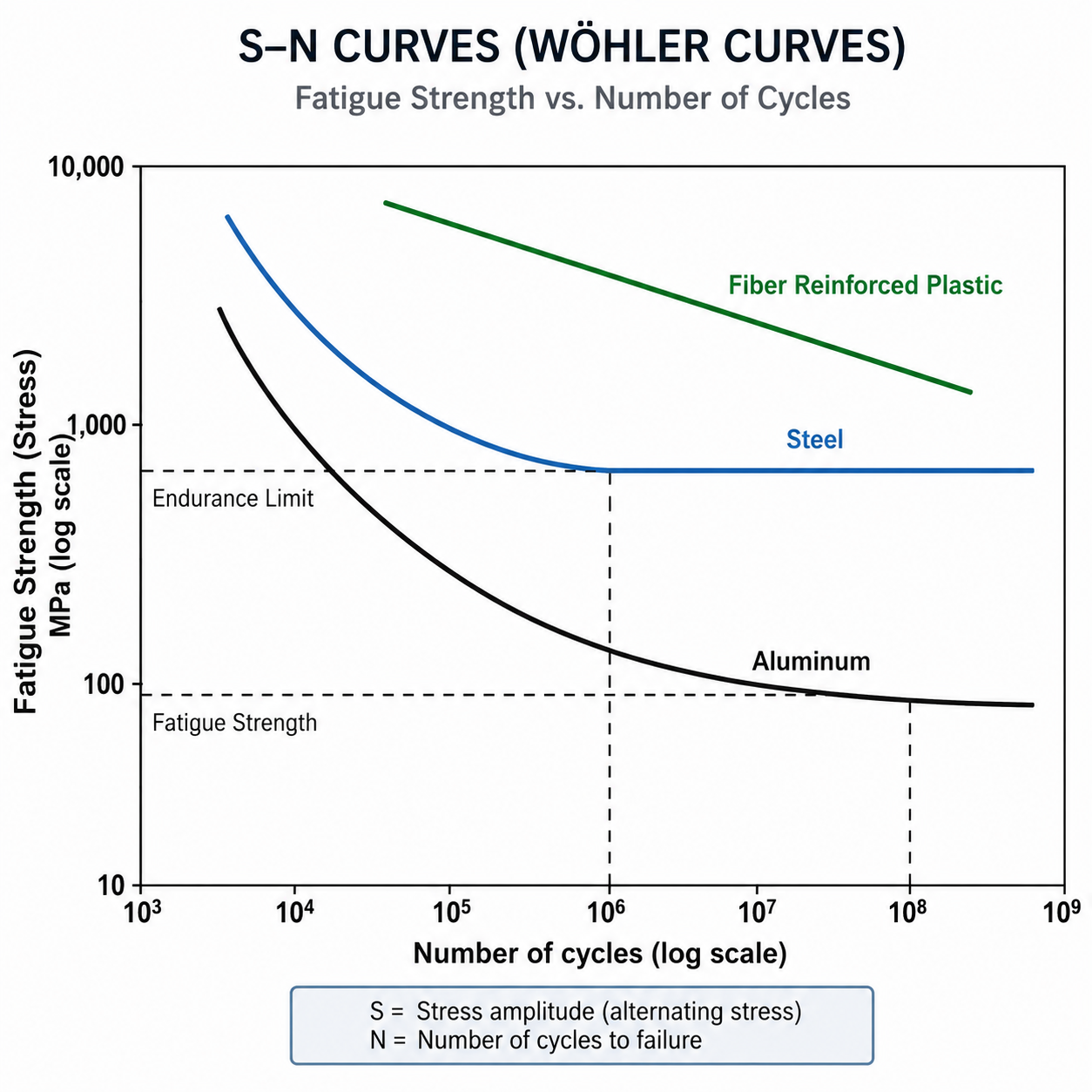
It is perhaps the most deceptive form of structural failure.
The bridge never experiences an extraordinary load.
It simply experiences an ordinary load…
millions of times.
And that changes the way engineers think.
When designing a railway bridge, the question is no longer:
Can this bridge carry today’s train?
It becomes:
Can it safely carry the next fifty million?
VI) Designing for Millions of Journeys
One of the biggest misconceptions about structural engineering is that stronger always means safer.
In fatigue design, that is not necessarily true.
A thicker steel plate may carry larger loads, but if a tiny crack forms at the wrong location, increasing its thickness alone will not prevent fatigue failure. Engineers therefore focus not only on how much force a member carries, but how that force is transferred through the structure.
This is why bridge details matter just as much as the bridge itself.
A perfectly smooth steel member distributes stresses relatively uniformly. Introduce a bolt hole, a rivet hole, a weld termination, or a sudden change in cross-section, and the stress no longer remains uniform. Instead, it becomes concentrated around these discontinuities.
Structural engineers refer to these regions as stress concentrations.
Ironically, the failure of a bridge member rarely begins in the middle of the member where the average stress is highest.
It usually begins at a tiny geometric imperfection only a few millimetres wide…
The Hohenzollern Bridge is a fascinating example of this principle.
Its riveted construction, characteristic of early twentieth-century steel bridges, contains thousands of connections. Every rivet hole, gusset plate, and connection detail represents a location where engineers pay particular attention during inspections. These are not weaknesses in the design; they are simply locations where fatigue damage is most likely to initiate after decades of cyclic loading.
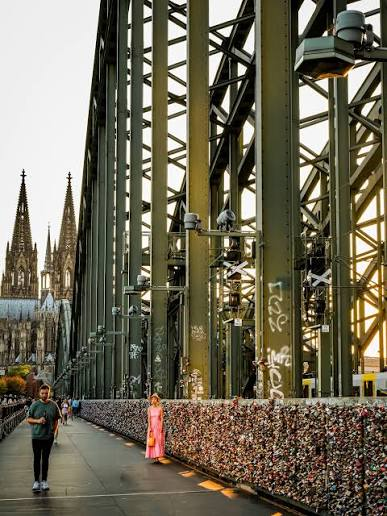
That is why bridge inspections are so different from building inspections.
Engineers are not looking for members that appear overloaded.
They are looking for cracks that have only just begun their journey.
Modern railway bridges therefore incorporate an entire philosophy known as fatigue design.
Instead of asking,
“Will this member yield?”
engineers ask,
“How many stress cycles can this detail survive before a crack is expected to initiate?”
That subtle difference has transformed bridge engineering.
It shifts the focus from maximum strength to service life.
VII) How Engineers Stay Ahead of Fatigue
Fatigue cannot be eliminated.
It can only be managed.
That is one of the most important principles in bridge engineering.
No engineer expects a railway bridge carrying thousands of trains every day to remain completely free of microscopic cracks forever. Instead, the objective is to detect those cracks long before they become structurally significant.
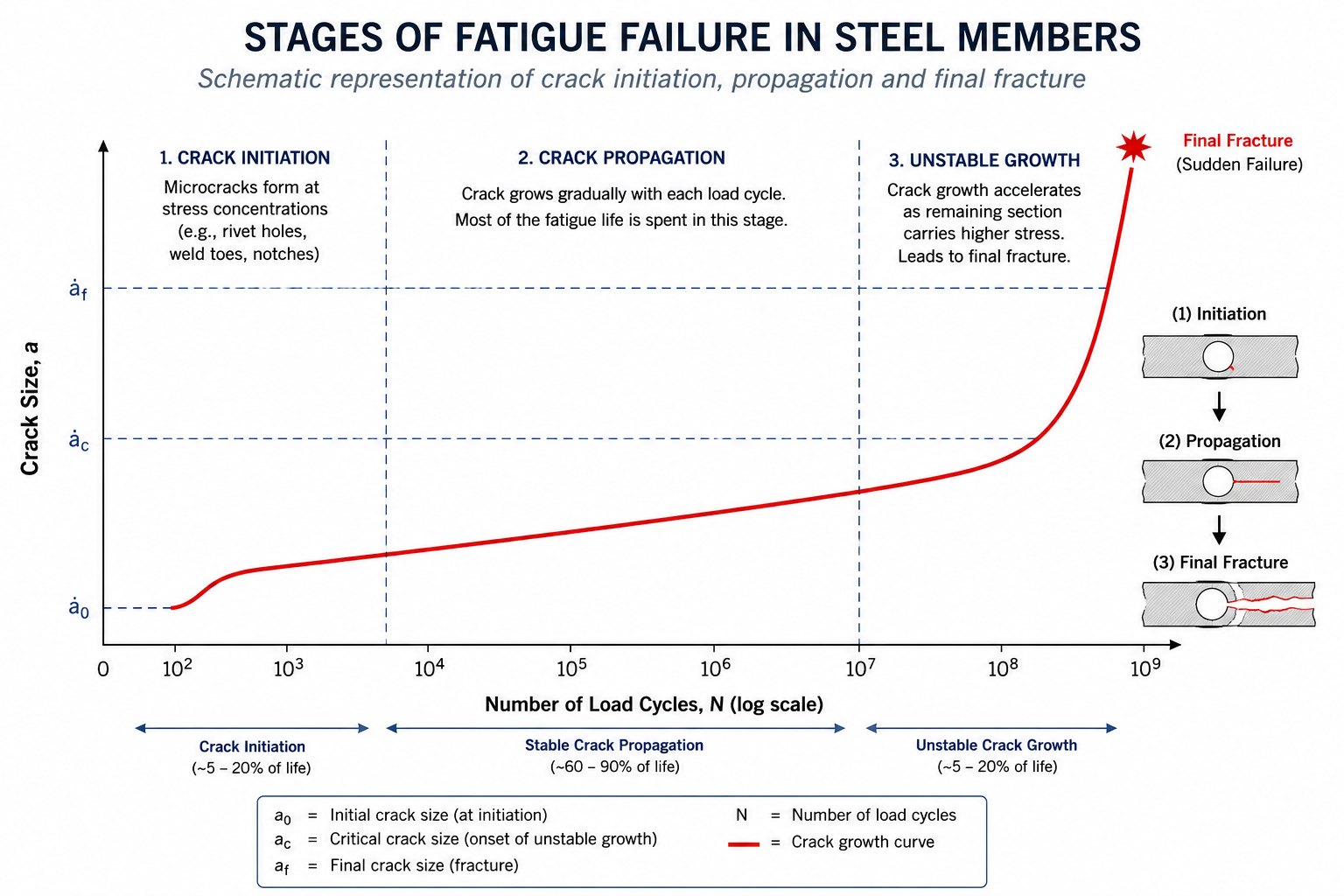
In other words, engineers do not wait for a bridge to fail.
They ensure it never gets the opportunity.
This philosophy has transformed bridge maintenance over the past century.
Modern railway bridges are no longer inspected only by what can be seen with the naked eye. Engineers employ a range of Non-Destructive Testing (NDT) techniques capable of identifying damage long before it becomes visible.
Ultrasonic testing uses high-frequency sound waves to detect internal cracks hidden deep within steel members. Magnetic particle inspection reveals surface and near-surface discontinuities around welded and riveted connections. Dye penetrant testing highlights extremely fine surface cracks that would otherwise escape detection.
Increasingly, bridges are also equipped with Structural Health Monitoring (SHM) systems. Strain gauges, displacement sensors, accelerometers, and vibration monitoring devices continuously measure how the bridge behaves under real traffic, allowing engineers to compare today’s performance with data collected years earlier.
The bridge is no longer inspected once every few years.
In many respects, it is constantly talking to engineers.
The challenge is learning how to listen.
For a bridge like the Hohenzollern, this level of monitoring is essential.
With more than 1,200 trains crossing the structure every day, shutting the bridge for major repairs is neither practical nor economically desirable. Maintenance therefore becomes a carefully planned engineering exercise. Individual members can be strengthened or replaced, connections repaired, corrosion removed, and protective coatings renewed—all while ensuring the bridge continues serving one of Europe’s busiest railway corridors.
Perhaps that is the greatest achievement of modern structural engineering.
Not designing bridges that never age.
Designing bridges that can age safely.
And perhaps that changes the way we should judge a bridge.
Not by how impressive it looks on the day it opens…
but by how reliably it performs a hundred years later.
VIII) What Hohenzollern Bridge Teaches Us at Kousain
The Hohenzollern Bridge has carried trains across the Rhine for more than a century.
Its steel has expanded and contracted through changing seasons. It has survived war, reconstruction, millions of train crossings, and countless cycles of loading that no human eye could ever perceive.
Yet its greatest lesson isn’t about steel.
It is about thinking beyond the day a structure is completed.
As structural engineers, it is easy to become consumed by calculations—member sizes, bending moments, reinforcement schedules, utilisation ratios. But a successful structure is not defined by whether it satisfies today’s design checks.
It is defined by how it performs after decades of service.
At Kousain, we believe great engineering is never about designing for the largest load alone.
It is about understanding how structures age.
How materials behave after millions of cycles.
How small details influence long-term performance.
And how thoughtful design, careful detailing, regular inspection, and responsible maintenance together determine whether a structure serves one generation… or several.
The Hohenzollern Bridge reminds us that engineering is not measured on the day a project is inaugurated.
It is measured every day thereafter.