The Sound You Never Heard
Every skyscraper sings.
Not a melody we can hear, but a rhythm the wind knows by heart — swirling, pulsing, pulling in perfect time.
That rhythm has a name: vortex shedding.
It’s the invisible music that makes tall towers tremble.
So when the Burj Khalifa began to rise — taller than any structure ever dared — everyone knew what would come next:
The wind’s song.
That low, unseen hum that could make even steel shiver.
But when the desert wind finally met the tower…
it fell silent.
The song broke.
The rhythm vanished.
And the tallest structure on Earth simply stood there, calm and unmoved, as if the sky itself had been fooled.

The Enemy You Can’t See
For most structures, it’s not brute wind pressure that causes chaos — it’s rhythm.
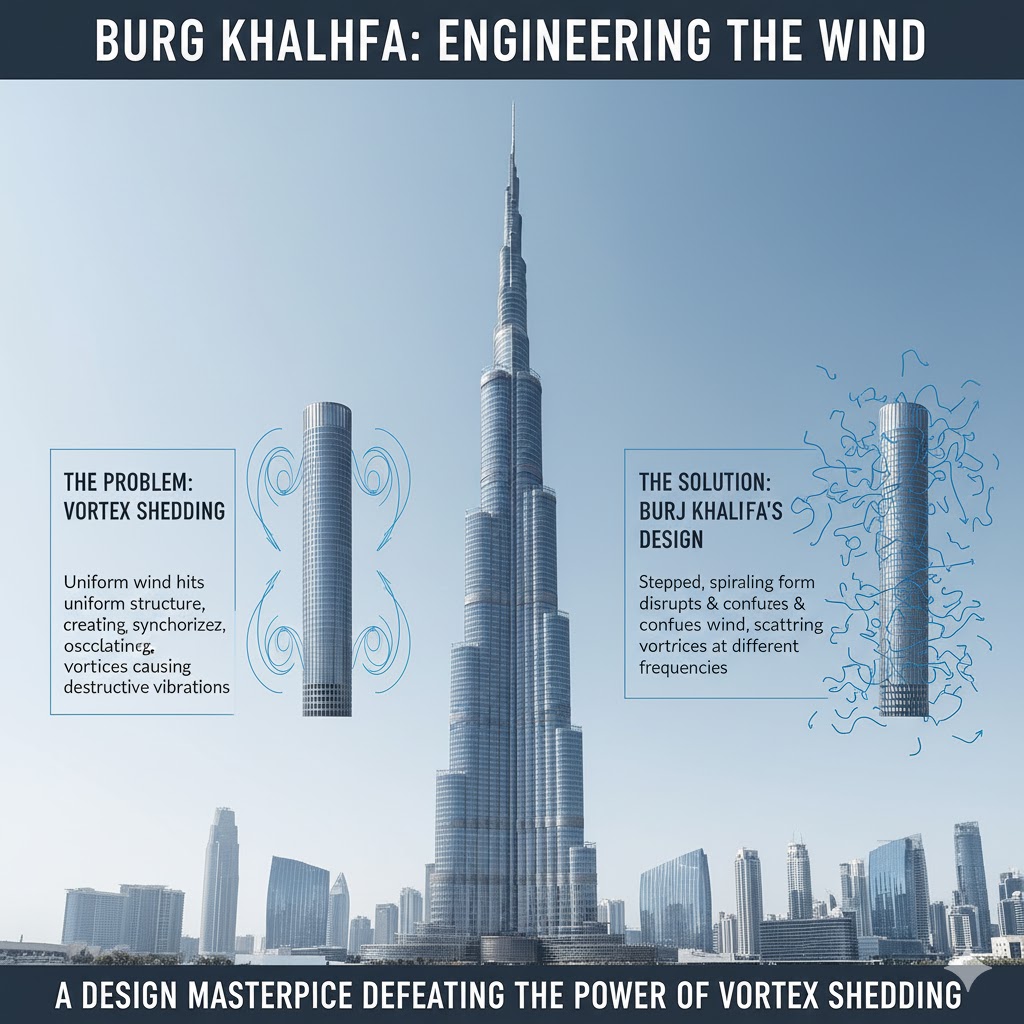
When air flows past a tall, slender structure, it doesn’t move evenly.
Instead, it dances — forming alternating swirls of air behind the structure.
These are called vortices, and they peel away from the sides one after another, left then right, left then right — like invisible footsteps in the air.
This phenomenon is known as vortex shedding.
Every time a vortex lets go, it tugs the building slightly in the opposite direction.
And when that shedding happens at a frequency close to the building’s own natural frequency, something terrifying begins — resonance.
The structure starts to sway, sometimes gently… sometimes violently.
And the taller the building, the greater the risk.

The Challenge of the Century
When engineers at Skidmore, Owings & Merrill (SOM) set out to design what would become the tallest building in the world, they knew that height wasn’t the only hurdle.
Wind — that invisible sculptor of skyscrapers — would dictate whether the dream could even stand.
The numbers were terrifying:
- Over 800 meters tall.
- Wind speeds reaching 200 km/h at the top.
- A structure so slender that even small oscillations could cause discomfort — or disaster.
Traditional aerodynamic shapes wouldn’t work.
Every design model that went into the wind tunnel seemed to hum with the same deadly rhythm: vortex shedding.

When Nature Has a Pattern, Break It
Enter Adrian Smith and Bill Baker, the lead architect and structural engineer.
They realized that to defeat the wind, they couldn’t overpower it — they had to confuse it.
Instead of fighting the rhythm, they decided to disrupt it.
And for that, they turned to nature once again.
The design took inspiration from the Hymenocallis, a desert flower with long, elegant petals spreading from a central core.
From above, the Burj Khalifa’s footprint would resemble a three-lobed Y shape — each wing gracefully extending outward.
This Y-shaped plan wasn’t just beautiful. It was genius.
The three wings worked like aerodynamic dampers, splitting the wind into multiple paths so it could never align perfectly.
The result?
The wind never knew where to push. Its rhythm was broken. Its dance disrupted.

The Secret in the Sky: Changing the Shape
But the engineers didn’t stop there.
They knew the wind would adapt, searching for patterns again — so the building itself had to keep changing.
As the Burj Khalifa rises, each tier twists slightly, and each wing steps back at different heights.
No two levels are the same.
This subtle shifting means that the vortices never find a consistent rhythm.
Every time the wind thinks it has found its beat, the tower changes the tune.
In the wind tunnel, the effect was astonishing — the once-powerful vortices now scattered, confused, and harmless.
The Burj Khalifa didn’t resist the wind.
It outsmarted it

A Symphony of Stability
The result is a structure that dances with the wind, not against it.
Sensors installed throughout the tower show that even in fierce storms, the movement at the top is barely perceptible — gentle, smooth, almost organic.
What once threatened to tear the structure apart now flows around it like water around a rock.
The Y-shaped core, the tapering setbacks, and the ever-changing geometry transformed what could have been a disaster into a masterpiece of stability and grace.

The Tower That Listens
The Burj Khalifa stands today not as a monument of dominance, but of understanding.
It doesn’t conquer the wind — it listens to it, studies it, learns its rhythm, and then quietly composes a new one.
That’s the secret of its stillness: it never gives the wind a chance to sing the same note twice.
Lessons from the Tallest
For every engineer, architect, or dreamer, the Burj Khalifa offers a simple truth:
“If you want to stand tall, learn how to bend.”
In a world obsessed with strength, it’s often adaptability that defines endurance.
The tallest structure ever built didn’t win by resisting — it triumphed by understanding.
At Kousain, we believe the future of engineering lies not in resisting natural forces,
but in understanding them — reshaping structures to flow with the world, not against it.