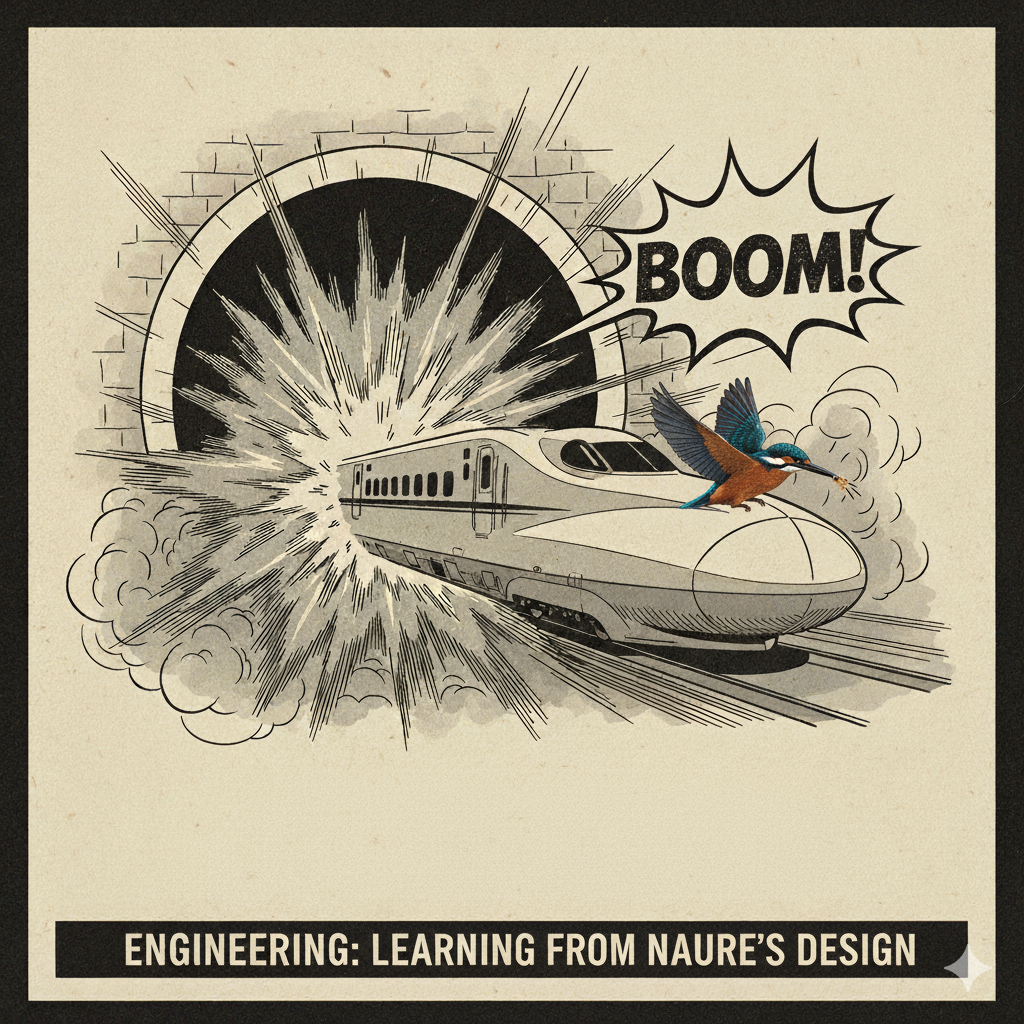
It began as a whisper. A low hum echoing through the tunnel — growing, deepening, swelling — until it exploded out the other end like a thunderclap tearing through the still air.
Windows rattled. Dogs barked. Birds fled. Villages miles away trembled each time Japan’s new bullet train tore out of a tunnel.
The Shinkansen, once the symbol of quiet precision and futuristic grace, had developed a dark side — the tunnel boom. It wasn’t just noise; it was shock. A pressure wave powerful enough to feel in your chest.
Engineers ran endless tests. Adjusted tunnel vents. Modified train noses. Still, the boom persisted — an invisible wall of air defying reason and science alike. And with every failed experiment, the silence of the lab grew heavier.
A Problem Without a Formula
At 300 kilometers per hour, air itself becomes a barrier. When a train enters a tunnel at such speed, it pushes a violent column of air ahead of it — a compression wave. By the time the train bursts out the other end, that wave releases like a cannon blast into the open.
The faster they went, the worse it got. Engineers found themselves trapped in a paradox: to make the train faster, it first had to become quieter.
But how do you silence a thunder born of physics itself?
The Engineer Who Watched the River
Among the noise and frustration was Eiji Nakatsu, a soft-spoken engineer — and, curiously, an avid birdwatcher. While his colleagues were buried in data, Nakatsu often spent his mornings by the river, camera in hand, studying the movements of birds.
One morning, a flash of blue caught his eye — a kingfisher perched above the water, still as an arrow before the strike. Then, in a heartbeat, it dove.
The bird pierced the surface — no splash, no ripple, no sound. Air to water, two worlds, and yet seamless.
Nakatsu stared, transfixed.
“Air to water… tunnel to open air…” he murmured. “What if the train could move like that?”
A close-up shot of a kingfisher mid-dive — beak first into calm water, with minimal splash. [Credits McFadyen]
The Shape of Silence
Back at the lab, Nakatsu began studying the kingfisher’s beak — that perfect taper, the smooth gradient of curves narrowing to a single sharp point. Nature, he realized, had already solved the problem.
The bird’s beak allowed it to transition between two mediums without turbulence — by controlling pressure change instead of resisting it. Exactly what the train needed to do.
So Nakatsu redesigned the Shinkansen’s nose — not as a blunt bullet, but as a bird’s beak. Longer. Sleeker. More organic. A design that seemed less engineered and more grown.
His peers were skeptical. Some laughed. But Nakatsu had a quiet confidence that only comes when nature has whispered the answer.
A side-by-side comparison: the beak of a kingfisher vs. the redesigned nose of the Shinkansen (N700 or 500 Series)
The Day the Boom Fell Silent
When the prototype finally rolled out for testing, engineers held their breath.
The train entered the tunnel. The familiar vibration began.
Then — nothing. No thunder. No echo. Only the soft sigh of air yielding to perfection.
The readings were astonishing:
Noise reduced by over 30%
Power consumption lowered by 15%
Speed increased by 10%
The kingfisher-shaped nose had not only silenced the boom — it made the train faster and more efficient.
For the first time, a man-made machine had learned to move with the grace of a bird.
When Nature Becomes the Teacher
Nakatsu’s solution didn’t come from equations — it came from observation, empathy, and awe. The Shinkansen’s kingfisher nose went on to become a global icon of biomimicry — engineering that imitates nature’s time-tested patterns.
It reminded the world that progress doesn’t always mean fighting against nature. Sometimes, it means listening to it.
The tunnel boom wasn’t silenced by force. It was silenced by understanding.
A Lesson for Every Engineer
At Kousain, we believe that true innovation happens where engineering meets imagination. Every challenge — from vibrations in a bridge to the roar of a tunnel — holds a secret pattern that nature has already solved somewhere.
We just need to watch closely enough to find it.
Because sometimes, the key to the quietest machine lies in the wings of a bird.