A King, a Crown, and a Question
In the ancient city of Syracuse, sometime around 250 BCE, a king had a problem that couldn’t be solved with swords or armies.
King Hiero II had given a craftsman pure gold to forge a crown. When it returned, the crown looked perfect — dazzling, heavy, and regal. But something about it troubled the king.
He suspected the goldsmith had secretly mixed silver into the gold — keeping some of the precious metal for himself.
There was only one problem: How could anyone prove it without melting the crown and destroying its beauty?
The king turned to one man — the city’s most brilliant mind, Archimedes of Syracuse, mathematician, inventor, and philosopher.
The Bathtub Moment — A Spark of Genius
Days passed. Archimedes pondered. He knew gold and silver had different densities, but the irregular shape of the crown made direct measurement impossible.
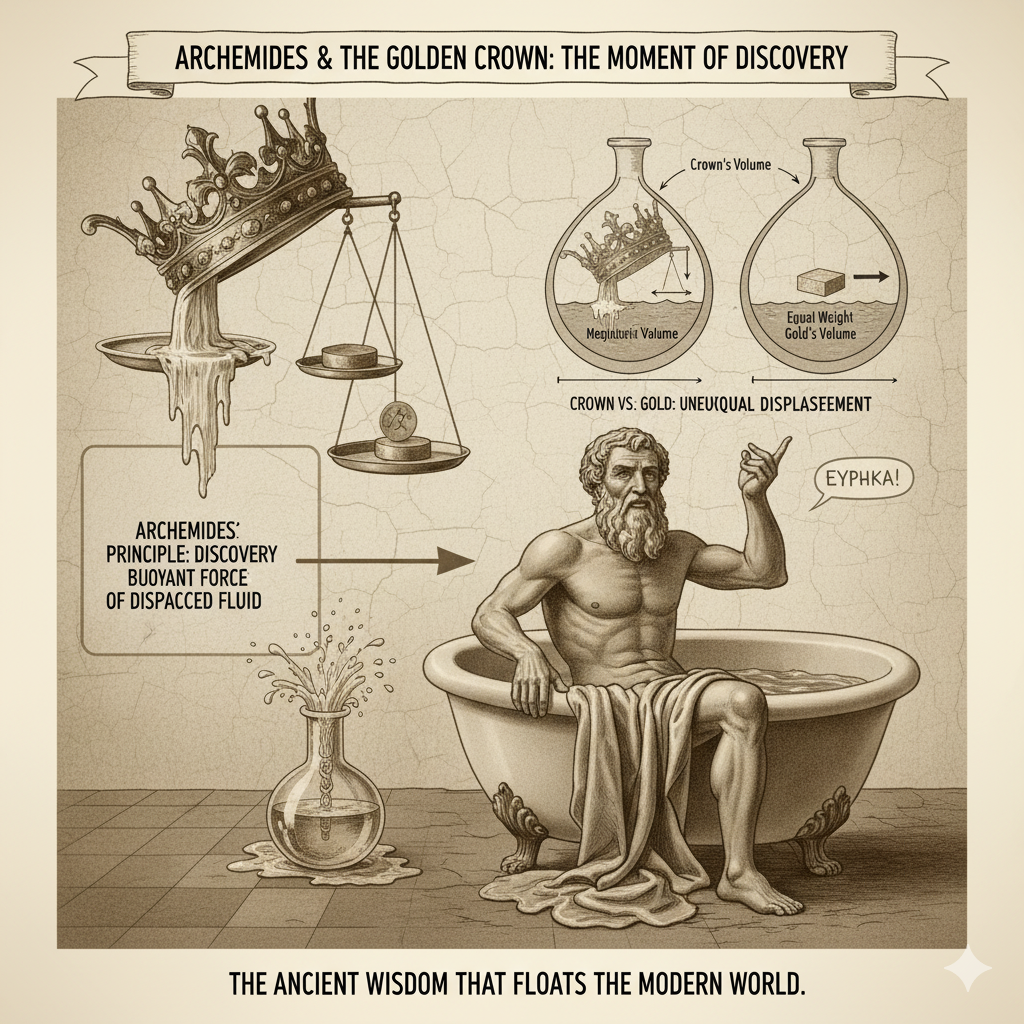
One day, as the story goes, Archimedes stepped into a bathtub and noticed the water level rise. Suddenly, something clicked.
He realized that the volume of water displaced was directly related to the volume of the object submerged.
If he could measure how much water the crown displaced compared to pure gold of the same weight, he could determine if it was genuine or alloyed.
The discovery was so thrilling that Archimedes supposedly ran through the streets shouting,
“Eureka!” — I have found it!
The Birth of Buoyancy
That moment in the bath led to the foundation of one of the most elegant principles in fluid mechanics — Archimedes’ Principle:
A body immersed in a fluid experiences an upward force (buoyant force) equal to the weight of the fluid it displaces.
In simple terms: If an object pushes away 10 kg of water, the water pushes back with a 10 kg force upward.
This invisible push — the buoyant force — is what allows everything from toy boats to aircraft carriers to float, as long as their average density (mass divided by volume) is less than that of the fluid they displace.
Archimedes tested the crown by submerging it and comparing displaced water to that from a lump of pure gold. The results betrayed the fraud — the crown displaced more water than pure gold of equal mass, proving it was mixed with a lighter metal. The craftsman’s deception was revealed, and buoyancy was born.
From Bathwater to Battleships — The Evolution of a Principle
Over the centuries, Archimedes’ discovery became the bedrock of hydrostatics — the study of fluids at rest. It explained why ships float, submarines dive, and hot air balloons rise.
Let’s trace the journey from that bathtub to the ocean’s giants:
1. The Early Applications
- Ancient sailors already knew that hollow wooden boats floated better than solid blocks, but they didn’t know why.
- Archimedes’ principle gave mathematical clarity to a practical truth — it was not the material, but the relationship between weight and displaced water, that mattered.
2. The Age of Exploration
- In the 15th to 17th centuries, as ships grew in size and complexity, naval architects relied on buoyancy and stability concepts to design hulls that balanced displacement, center of gravity, and metacentric height — ensuring they didn’t capsize in rough seas.
3. The Industrial Era
- The 19th century brought iron and steel ships — materials much denser than water. Many skeptics thought they would sink. But thanks to Archimedes’ principle, engineers knew that a hollow steel hull with enough internal volume could displace sufficient water to stay afloat. It wasn’t the material that mattered — it was the geometry.
4. The Modern Age
- Today’s massive cruise liners, oil tankers, and naval carriers — weighing over 200,000 tons — still obey Archimedes. Their hulls are shaped to displace immense volumes of water, generating buoyant forces that perfectly counteract their colossal weight. Even the Three Gorges Dam ships or floating LNG terminals rely on precise buoyancy and stability analyses derived from Archimedes’ equations.
The Science That Never Sank
The beauty of Archimedes’ principle lies in its universality. It doesn’t care about technology, scale, or material — only about weight and displacement.
It’s the same reason:
- A steel ship floats, but a steel nail sinks.
- A diver feels lighter underwater.
- Submarines control depth by filling or emptying ballast tanks — changing their average density.
It’s also why modern engineers spend months simulating hydrostatic balance, buoyancy centers, and stability margins — the same ideas Archimedes discovered two millennia ago.
The math may be digital now, but the principle remains eternal.
From Crown to Colossus — A Legacy That Floats
From a gold crown in Syracuse to floating megastructures that cross oceans, Archimedes’ principle has quietly supported human progress for over 2,000 years.
The king’s suspicion may have exposed a fraud — but it also unveiled one of nature’s most perfect laws.
Next time you see a massive ship gliding effortlessly across the water, remember: it’s not magic, it’s math — and it all began with a curious mind, a royal puzzle, and a splash in a bathtub.
At Kousain Engineering, we believe the greatest breakthroughs often come from the simplest questions — and Archimedes proved that sometimes, one Eureka moment can keep the whole world afloat.