The Mind That Bridged Worlds
Few names carry the gravity of Leonardo da Vinci. Painter. Mathematician. Anatomist. Inventor. Astronomer. Engineer.
To list his talents feels almost absurd — as if one lifetime were too small to contain them all.
Yet what made Leonardo extraordinary was not merely his range, but the connection between his curiosities. The same eye that studied the curve of a tendon also traced the arc of a bridge; the same mind that mapped human anatomy also mapped the anatomy of force.
To Leonardo, nature was a network of relationships — pressure, flow, resistance, harmony. Whether it was blood in veins or water in rivers, he saw the same underlying laws at work.
And that understanding, drawn from art and science alike, gave him a gift few engineers of his era possessed: the intuition that beauty and structure were the same language.
The Problem Before Leonardo — Heavy Bridges, Slow Spans
In the 15th century, bridge building was an ordeal.
Massive stone arches demanded enormous wooden scaffolds — “centrings” — that had to be built under every span before the stones could be placed. These were expensive, time-consuming, and often dangerous, especially in deep valleys or wide rivers.
To build a bridge was to battle both gravity and time.
Leonardo saw this inefficiency clearly. His notes are full of sketches of arches, cables, and temporary assemblies — ideas that seemed to whisper: “What if the bridge could stand by itself as it was built?”
That single question changed everything.
A Bridge for the Sultan — The Golden Horn Dream
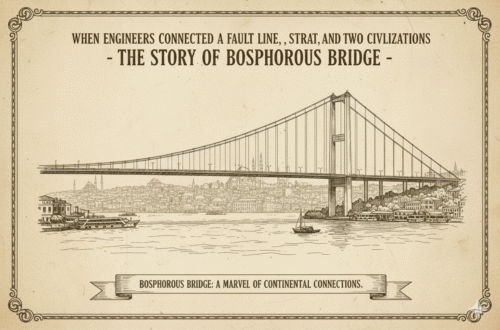
In 1502, Sultan Bayezid II of Constantinople (modern-day Istanbul) invited designs for a bridge across the Golden Horn, a long, deep inlet dividing the city.
Most proposals were practical, cautious, predictable.
Leonardo’s was revolutionary.
He drew a single-span arch — 240 meters long — rising in a flattened, graceful curve.
No columns. No supports in the water. Just a clean, continuous form resting on its abutments.
To engineers of that age, the concept was madness.
To Leonardo, it was geometry in motion.
Five centuries later, structural analyses proved him right. Modern computer simulations show that his chosen curvature — part parabolic, part catenary — would have kept the line of thrust (the path through which compressive forces travel) safely within the arch’s body.
That means the bridge would have stood, stable and strong, without cracking or overturning — a feat unthinkable in 1502.
“The bridge stands by virtue of its form alone.” — Leonardo da Vinci (Codex Atlanticus, fol. 855r)

Self-Supporting Bridges — Geometry as the Engineer
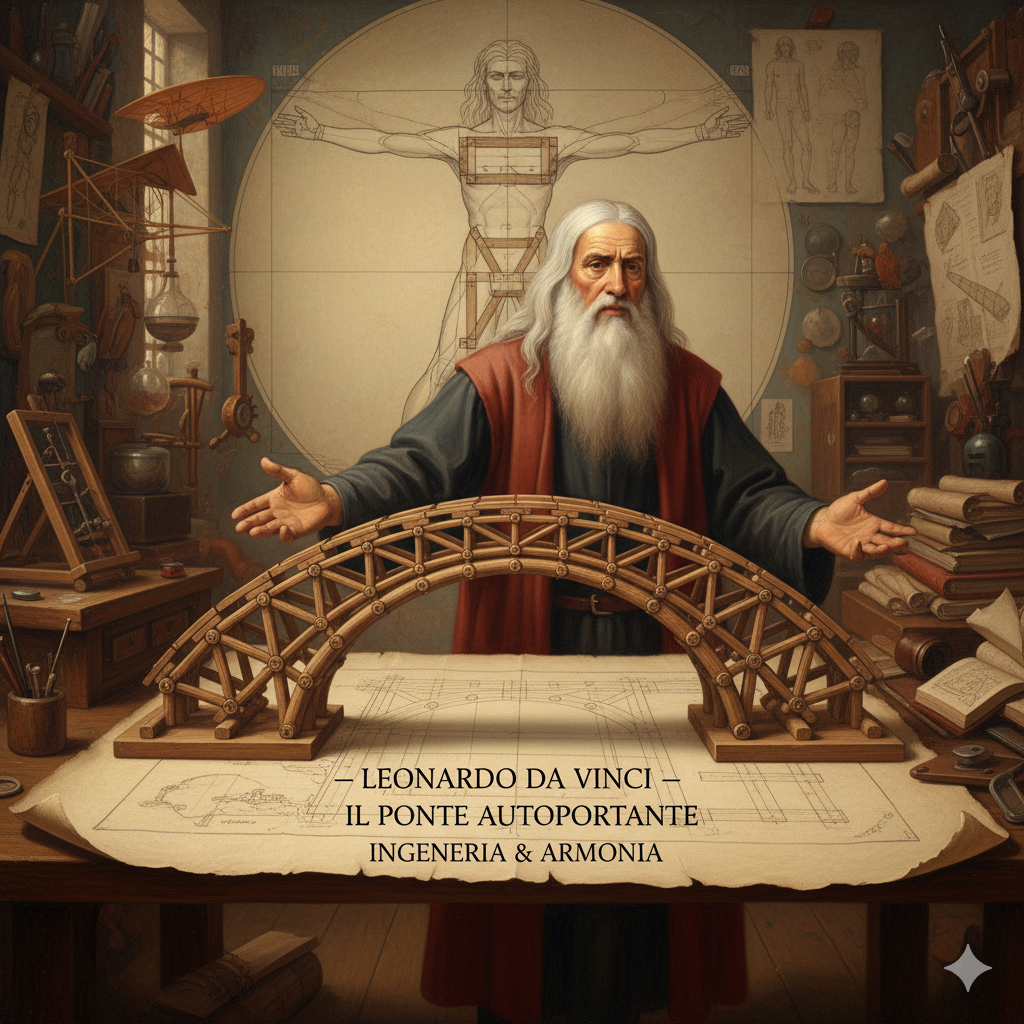
Among Leonardo’s most ingenious ideas were his self-supporting bridges — structures that could be assembled without nails, ropes, or scaffolds.
Each timber leaned upon the next, forming an interlocking lattice of compression and friction. Once the final member was inserted, the entire structure “locked,” distributing load through contact and geometry alone.
Modern engineers recognize this as a compression-only structure — every member carries load through pushing, not pulling.
It’s the same principle that makes an arch stable or a masonry dome eternal.
Remove one beam, and the load path breaks; assemble them correctly, and the system strengthens itself with every piece added.
These bridges could be rapidly deployed — ideal for military campaigns — yet they carried a philosophical elegance: the structure was its own scaffolding.

The Science Beneath the Beauty — Understanding His Genius
Leonardo’s grasp of structure predates formal structural mechanics, but his intuition matches modern understanding remarkably well. Let’s unpack why.
- Compression-Only Forms
The most efficient bridge carries its load purely in compression. Tension causes cracking in brittle materials like stone, but compression keeps them together. Leonardo’s flattened arches did exactly this — the curvature was such that every particle of the bridge “wanted” to stay in place. - The Line of Thrust
Imagine tracing the invisible path that the load follows as it moves through the bridge — that’s the line of thrust.
If this path stays within the arch’s thickness, the structure remains in pure compression.
Leonardo’s sketches reveal curves so natural and balanced that they anticipate modern funicular shapes — the same forms engineers now compute using the principle of minimum thrust. - Proportion and Scale
Leonardo’s proportions were never random. In his bridge sketches, the rise (height) to span (length) ratio usually falls between 1:5 and 1:6 — an optimal range for minimizing horizontal thrust while keeping a low profile.
These ratios appear centuries later in the work of Eiffel, Maillart, and Freyssinet. - Material Logic
Though he used timber or masonry in concept, Leonardo’s ideas were material-agnostic. His bridges were designed around form, not material — a design philosophy that foreshadows the modern concept of form-finding, later revived by Frei Otto and Gaudí.
Portable, Revolving, and Pontoon Bridges — Engineering Mobility
Not all of Leonardo’s bridges were monumental.
In the Codex Atlanticus, he described bridges that soldiers could carry, rotate, or float.
- Revolving Bridges: A timber deck balanced on a pivot, able to swing quickly across a moat or narrow stream — like the ancestor of the modern drawbridge.
- Portable Bridges: Prefabricated trusses assembled from modular pieces; strong, fast, and light.
- Pontoon Bridges: Floating platforms connected by ropes or frames — a nod to naval engineering and fluid mechanics.
Each concept emphasized speed and simplicity, rooted in Leonardo’s deep study of statics and the behavior of water.
They reveal an engineer who thought not just about structure, but about logistics — how to build quickly, dismantle easily, and move efficiently.

A Renaissance Idea Realized — Norway, 2001
Five hundred years after Leonardo’s pen touched parchment, his dream finally took shape.
In 2001, a pedestrian bridge was built in Ås, Norway — based directly on his Golden Horn proposal.
Designed by Norwegian artist Vebjørn Sand and engineered with modern timber and steel, the bridge stretches elegantly across the highway — its form nearly identical to Leonardo’s sketch.
It’s not just a tribute; it’s validation.
His geometry works.
His idea lives.

Legacy — When Vision Becomes Structure
Leonardo da Vinci never built a bridge himself. Yet in many ways, all of us who study or design structures walk across the bridges he imagined.
He taught that a bridge is not just a crossing of space, but a crossing of ideas — between art and science, imagination and calculation.
His sketches remind us that structure can be beautiful, and beauty can be structural.
That geometry can replace material.
That simplicity can hold power.
In every parabolic arch, in every compression-only vault, in every designer’s sketch seeking elegance and efficiency — Leonardo is still there, drawing quietly in the margins.