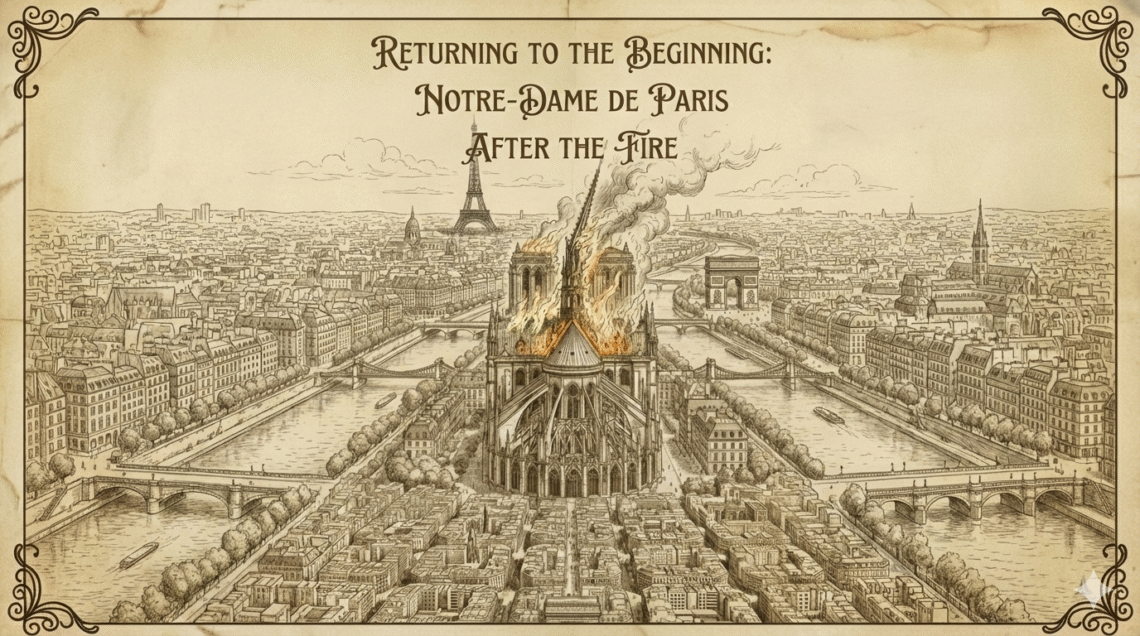
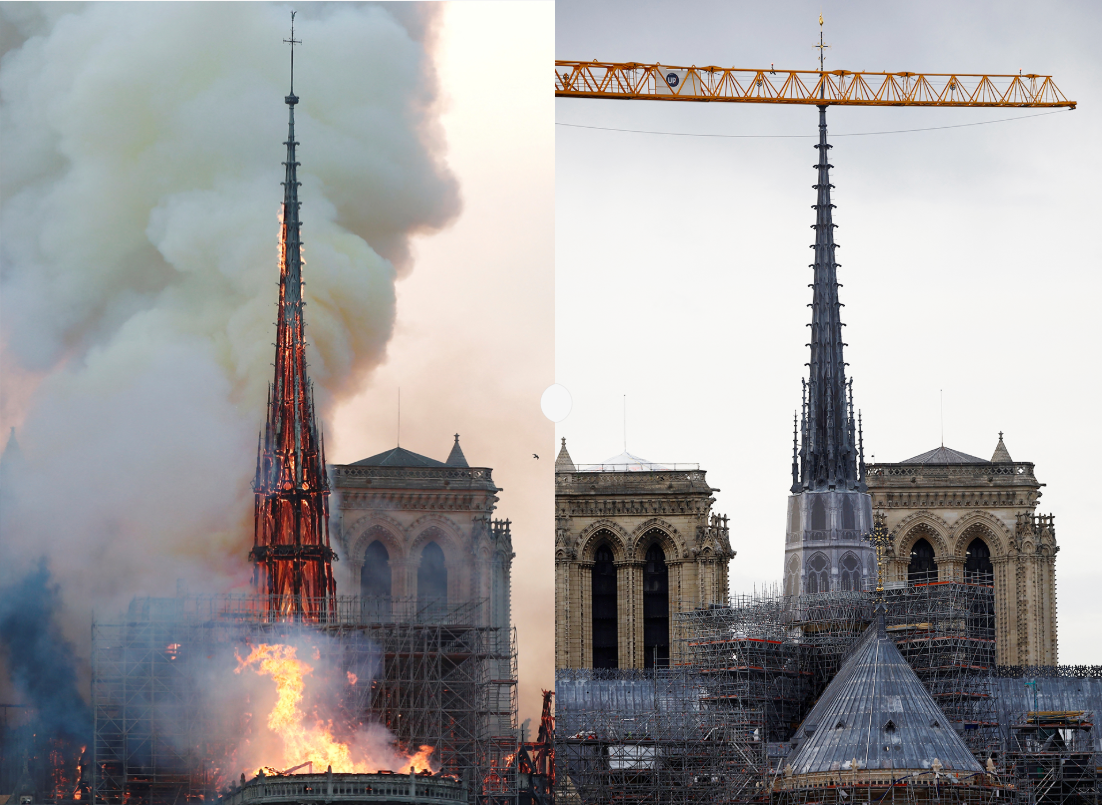
A Quiet Moment on the Seine: Seeing the Reassembled Spire
Paris, City of Lights (La Ville Lumière), begins at Notre-Dame, a symbol of Christianity in France
Notre-Dame de Paris officially reopened on 7 December 2024.
Five years after the fire.
More than €700 million spent.
Over 2,000 artisans and engineers involved.
What had burned was rebuilt, what had weakened was stabilized, and what had been scattered was carefully reassembled—stone by stone.
So when we saw Notre-Dame for the first time on 12 January 2025, it wasn’t curiosity that brought us there.
It was to see what had been put back into balance.
We had already climbed the Eiffel Tower, walked through Paris’s central churches, and seen the city from above. But Notre-Dame was different. We stood quietly along the Seine River, looking at a structure that had just survived the one thing medieval builders feared most.
Fire.
Notre-Dame had endured centuries of load and time; fire was the first true rupture.
And it was still standing.
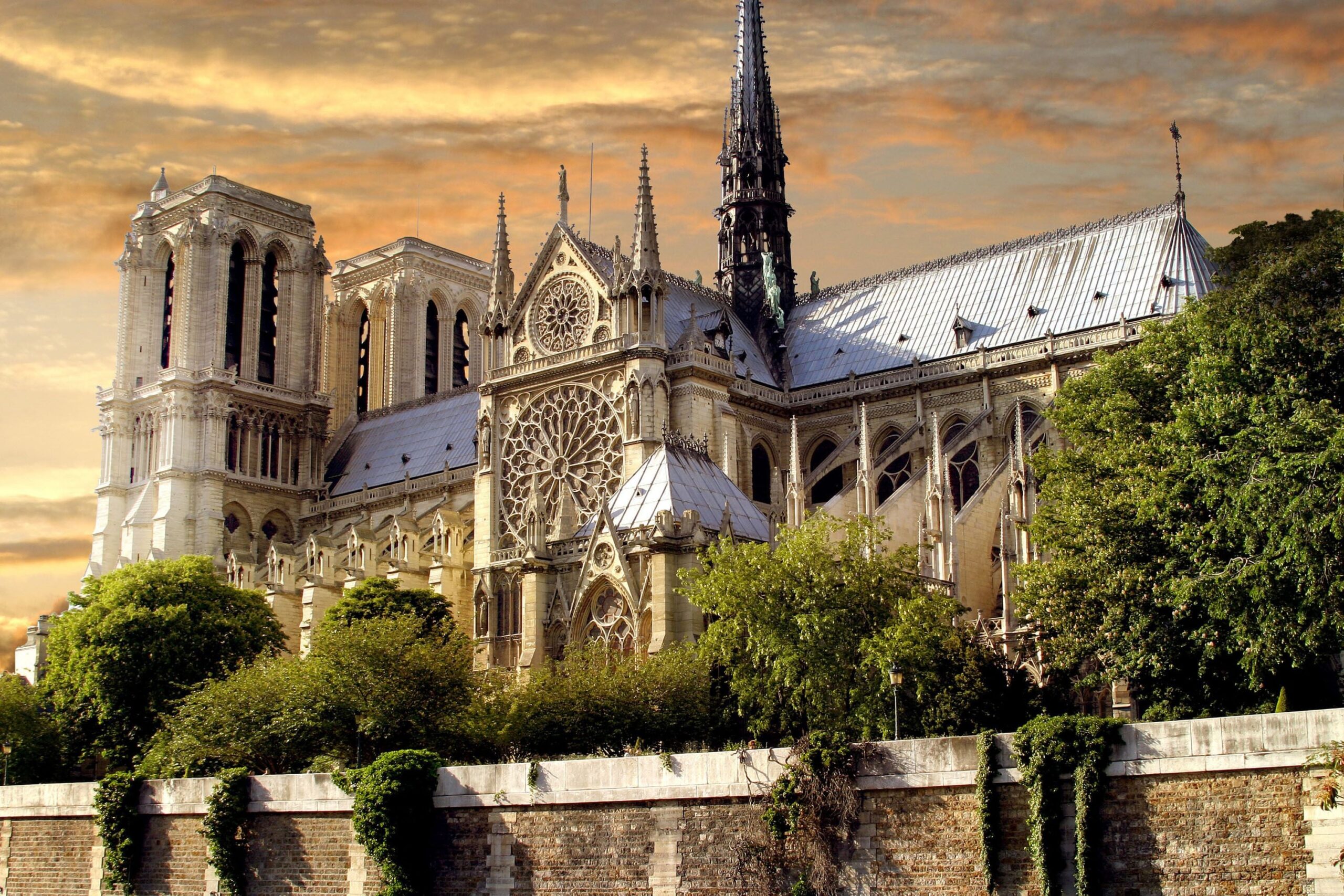
Before the Fire — A Structure Built to Last Longer Than Its Builders
Construction of Notre-Dame began in 1163 and continued for nearly 200 years.
That matters structurally.
Because it means:
- evolving geometry
- incremental refinement of load paths
- different master builders
The cathedral is not a single idea.
It is centuries of engineering decisions stacked in stone.
The nave rises to about 35 meters, made possible by flying buttresses that redirect horizontal thrust outward instead of into the walls. This allowed thinner masonry, larger stained-glass openings, and a structure that works almost entirely in compression.
Above the stone vaults sat the timber roof — la forêt — built from more than 1,300 oak trees, many already centuries old when they were cut. Each beam was unique, hand-shaped, and placed assuming one thing:
If the roof fails, the vaults must not.
That assumption would be tested in 2019.
April 15, 2019 — The Fire That Found the Weakest Layer
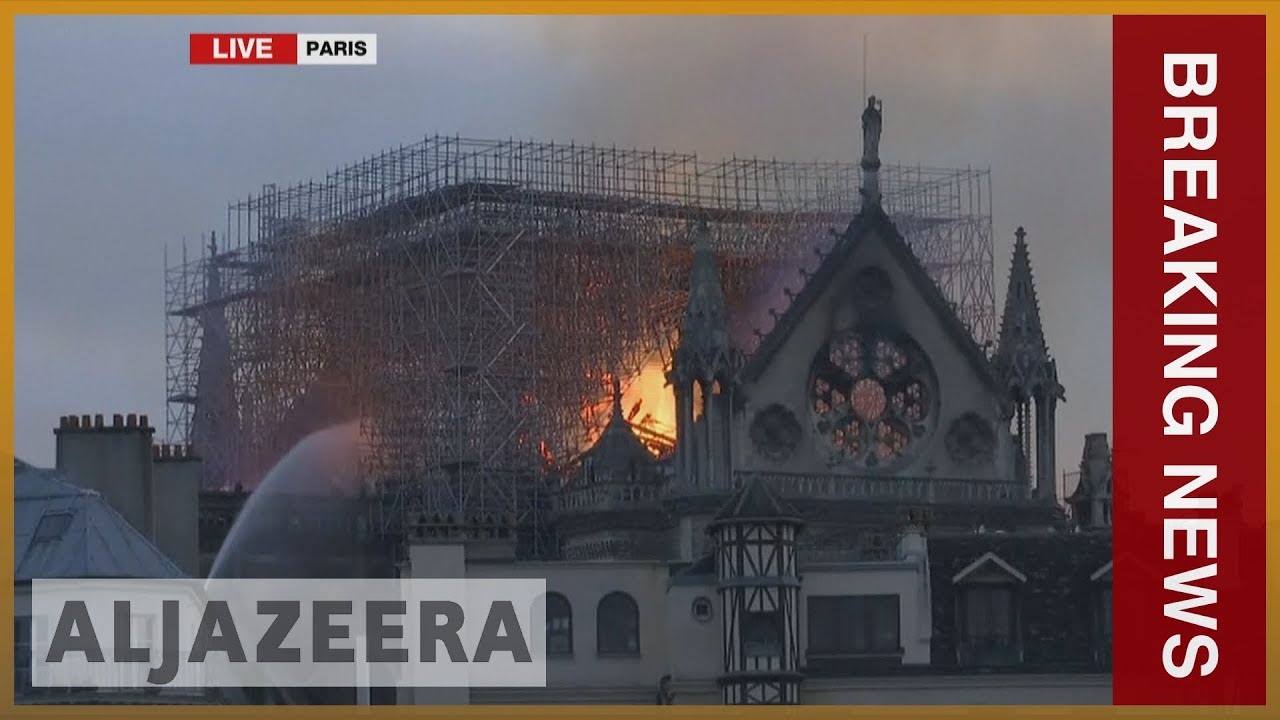
The fire began in the roof.
The medieval oak trusses burned rapidly, reaching temperatures estimated between 800–900°C. The spire — a 19th-century addition by Eugène Viollet-le-Duc — collapsed. Molten lead flowed through the structure.
From a structural standpoint, the fear was immediate:
- loss of roof dead load
- thermal cracking in limestone
- destabilization of arches and buttresses
Yet the cathedral did not collapse.
Post-Fire Reality — Making a Ruin Stand Still
What followed was not restoration.
It was structural stabilization under uncertainty.
Before Notre-Dame could be rebuilt, it first had to be made safe to exist. The responsibility fell to the chief architect of historic monuments, Philippe Villeneuve, working alongside structural engineers from Artelia and a network of specialized heritage contractors.
Nothing could be assumed.
The fire had subjected the limestone to extreme thermal shock. Timber had vanished, altering load paths that had been stable for centuries. Molten lead had flowed through joints never meant to see such high temperatures.
Before a single stone could be moved, engineers had to confront uncomfortable questions:
Are the vaults cracked but hidden?
Have the buttresses rotated outward?
Are walls still plumb after thermal shock?
These were not academic concerns. A wrong assumption could trigger progressive collapse.
So nothing was touched.
Instead, the cathedral was measured, scanned, monitored, and restrained. Sensors were installed. Geometry was checked against pre-fire records. Temporary supports were added not to rebuild, but to freeze the structure in time.
Only when the answers were known—quantified, not guessed—did reconstruction begin
BIM and Notre Dam Resurrection
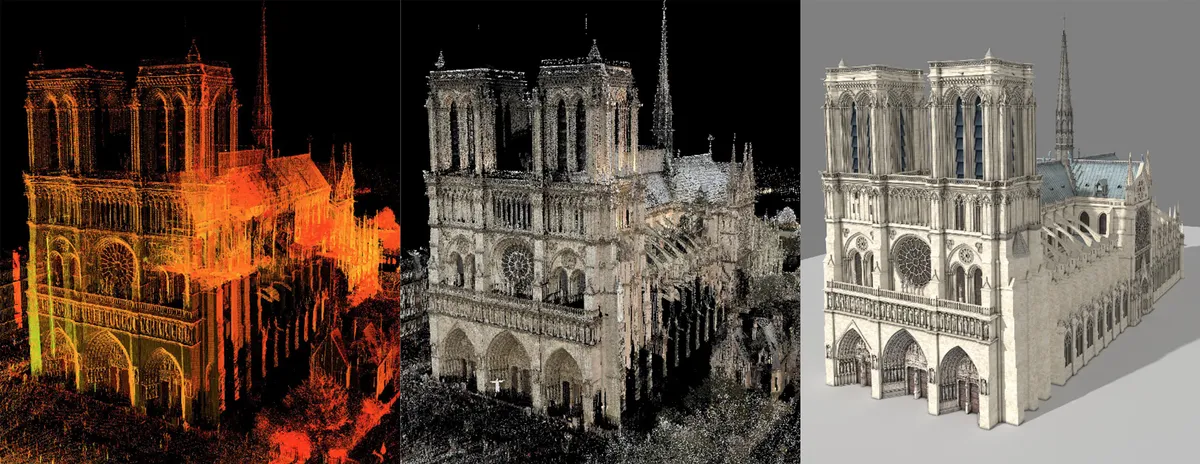
In the aftermath of the fire, Notre-Dame became one of the most digitally documented structures in history — not through guesswork or sketches, but through a comprehensive data ecosystem that mapped the building down to millimetre precision. This was not monitoring as an afterthought; it became the backbone of the entire reconstruction strategy.
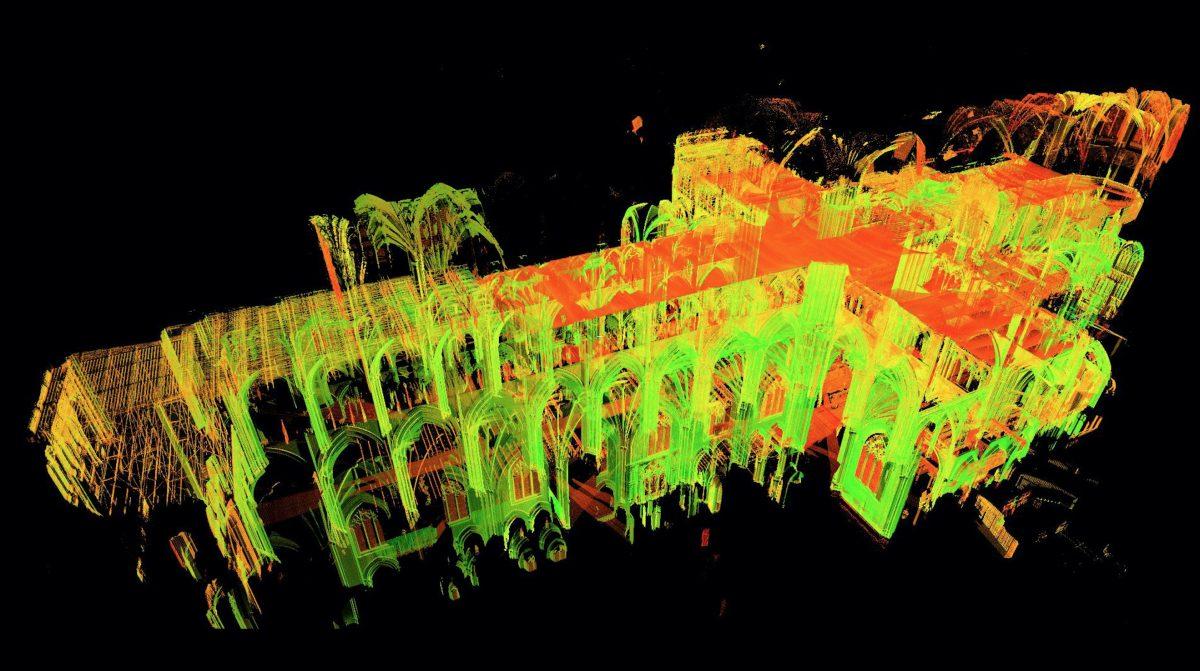
Millions of laser points were fired across Notre-Dame’s surfaces — walls, vaults, buttresses, tracery — recording geometry with millimetre accuracy.
High-resolution LiDAR scans transformed the cathedral into dense point clouds, capturing every deviation, crack, and curvature. This effort was only possible because pre-fire scans already existed — quiet academic work done years earlier that suddenly became invaluable.
Where lasers could not reach, photogrammetry filled the gaps.
Thousands of overlapping photographs were stitched together, not for beauty, but for truth — surface texture, stone condition, deformation patterns. Ornament stopped being decoration and became measurable material.
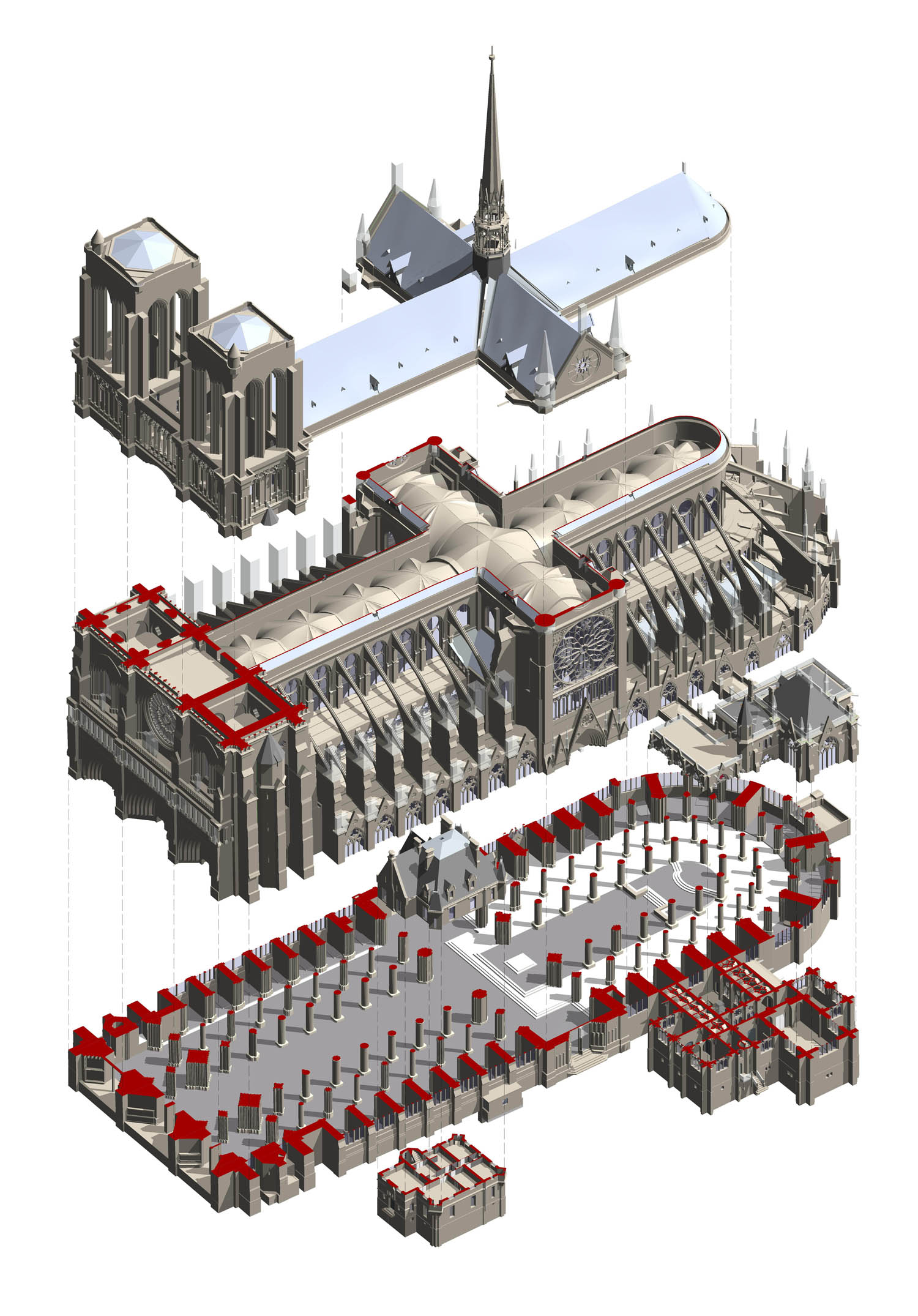
All of this data converged into a single environment:
a Building Information Model (BIM) — Notre-Dame’s digital twin.
Inside this model, engineers could:
- compare pre-fire and post-fire geometry
- identify shifted vaults and stressed arches
- test temporary supports before installing them
- plan reconstruction sequences without risking collapse
For the first time, medieval stone and timber could be simulated before being touched.
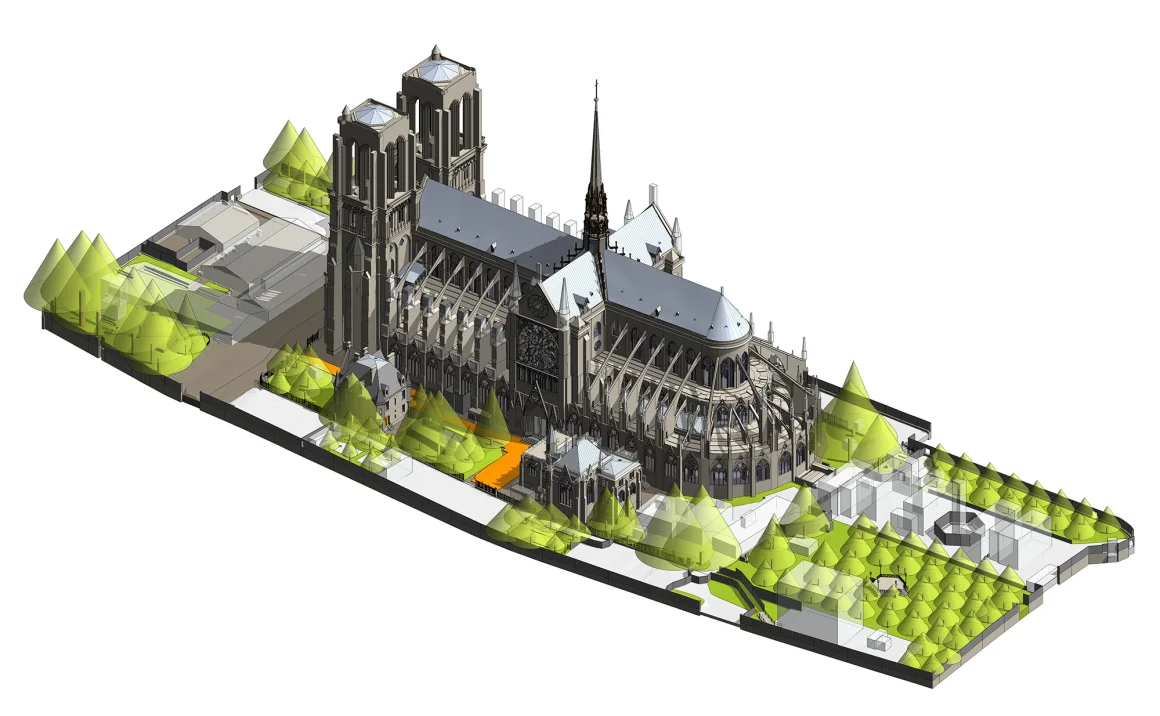
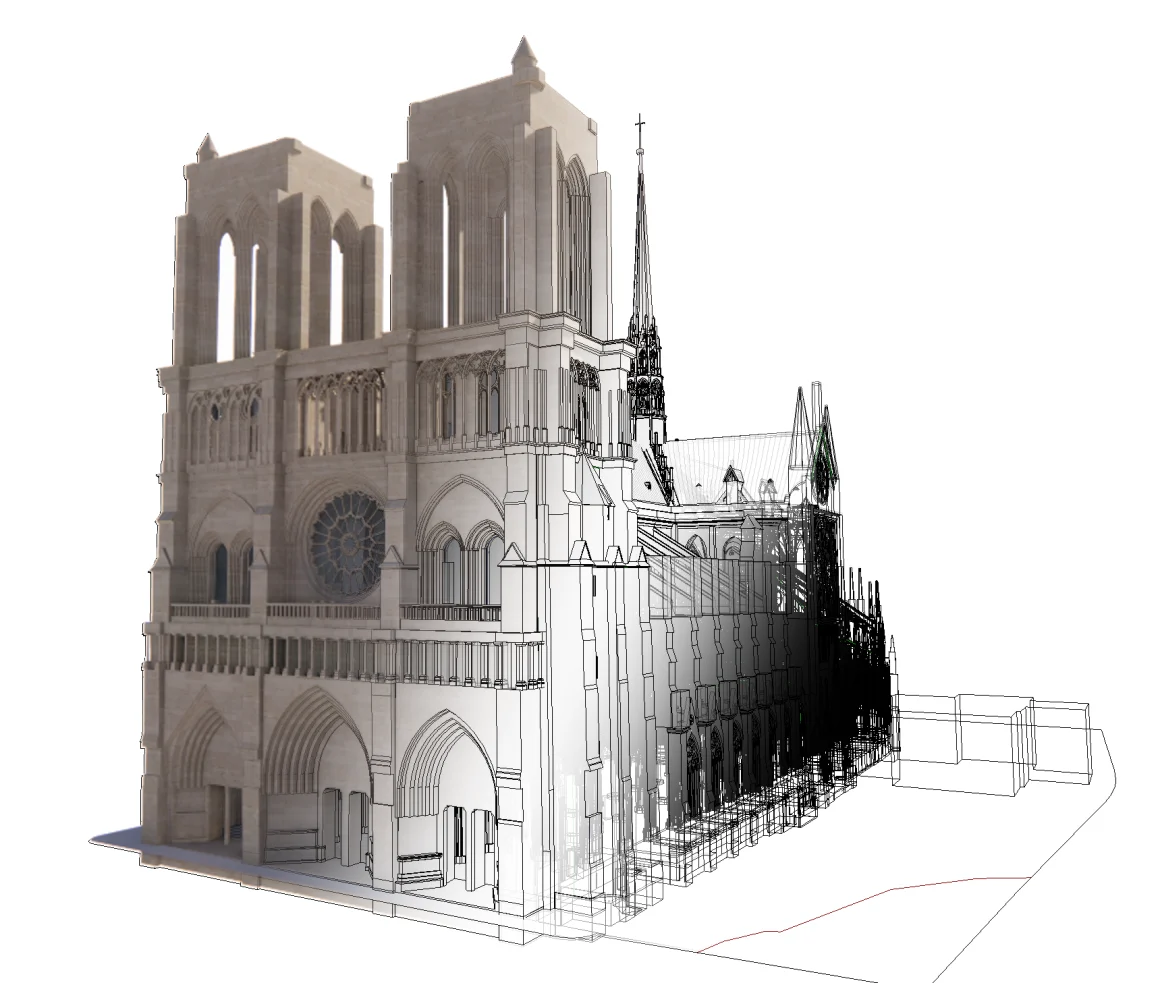
[Credit: Autodesk]
Engineers and heritage specialists combined multiple state-of-the-art techniques to capture the cathedral’s geometry and condition.
This digital twin was more than a snapshot — it became a working blueprint. Pre-fire laser scans, some made years earlier by researchers, provided the most accurate measurement up to five millimetres — a level of precision critical when rebuilding intricate details like vaulted ceilings and flying buttresses.
With the digital twin, architects and restoration experts were able to compare pre-fire geometry with post-fire conditions, identify where elements had shifted or suffered stress, and plan stabilization measures with confidence. It allowed them to simulate reconstruction sequences, test structural responses to temporary supports, and even coordinate traditional craftsmanship with modern safety requirements.
In essence, for the first time in its nearly 850-year history, Notre-Dame did not have to be interpreted, it could be measured and understood as data.
The Roof — Rebuilding La Forêt
When proposals arrived imagining glass canopies, rooftop gardens, even pools suspended above the nave, engineers responded with a single question:
“Where does the load go?”
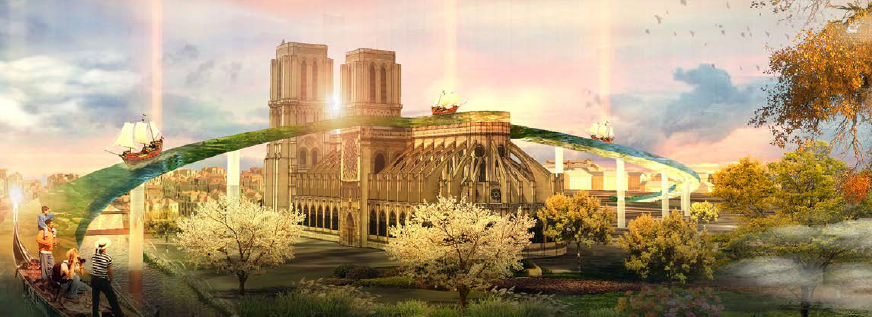
France made a controversial but deliberate decision:
The roof would be rebuilt exactly as it was.
Rebuilding Notre-Dame’s roof proved to be the most structurally delicate decision of the entire restoration. The original timber structure, known as la forêt, dated back to the 12th century and was formed from more than 1,300 oak trees, creating a truss system whose mass and stiffness had worked in balance with the stone vaults and flying buttresses for over 850 years. Replacing it with steel or lighter materials would have reduced dead load but also shifted thrust lines and altered long-term deformation patterns within the masonry.
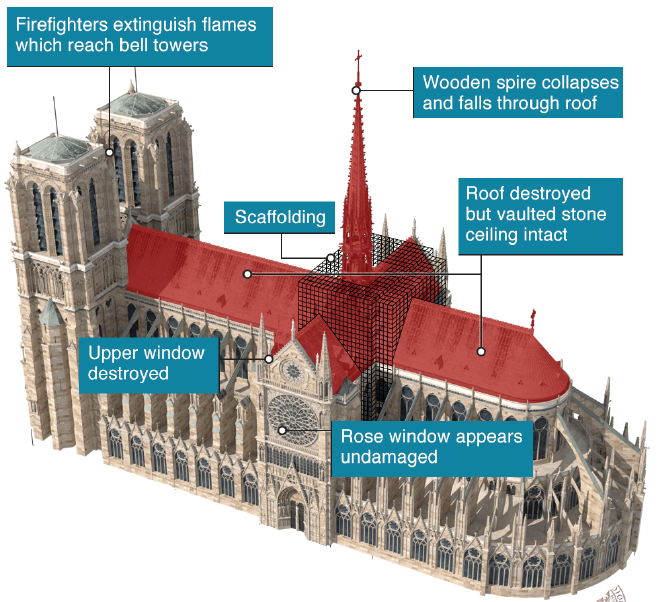
Engineers therefore chose to rebuild the roof exactly as it was, not out of nostalgia, but to preserve known load paths and proven structural behavior. This decision required sourcing slow-grown oak, shaping thousands of unique members, and reassembling the roof geometry with millimetre-level accuracy, while quietly integrating modern fire detection, compartmentalization, and continuous monitoring systems.
The result is a roof that weighs, behaves, and ages like its medieval predecessor—yet is protected by 21st-century safety systems designed to prevent the conditions that once brought it down.
More Than Rebuilding — Correcting the Future
Behind the restored stone and timber, Notre-Dame now includes:
- modern fire detection
- improved compartmentalization
- discreet suppression systems
- continuous structural monitoring
Nothing visible was compromised.
Nothing structural was left to chance again.
What Notre-Dame Leaves Behind — A Kousain Reflection
Notre-Dame did not survive because it was indestructible.
It survived because its structure was understood.
Clear load paths, honest materials, and restraint where restraint mattered most allowed engineers, centuries later, to intervene without reinventing the building.
At Kousain, this is a reminder that good engineering does not shout innovation.
It leaves behind structures that can still be reasoned with — even after fire.