Introduction: A City That Shook Unevenly
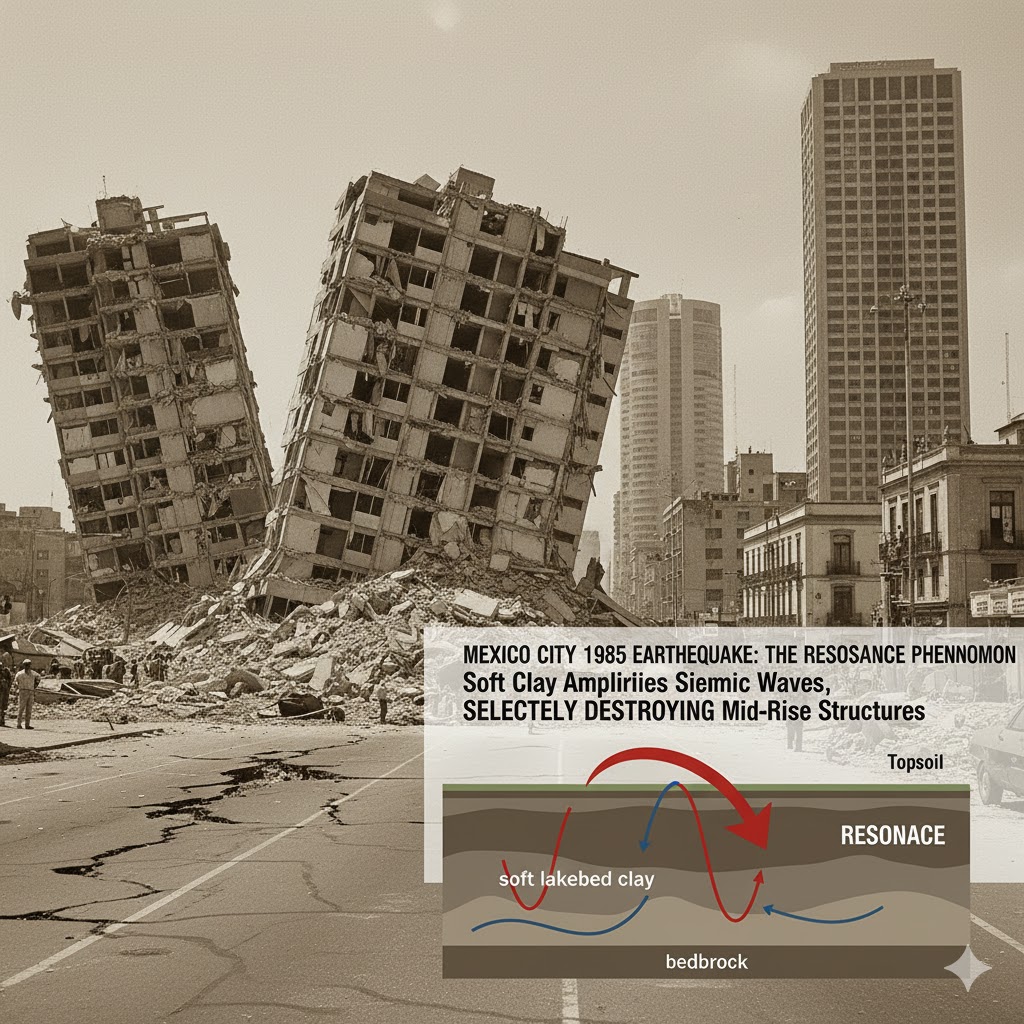
When the powerful 1985 Mexico City earthquake struck, engineers around the world were baffled. Skyscrapers still stood proudly, small houses mostly survived — yet mid-rise buildings, those between 6 to 15 storeys, were reduced to rubble.
Why did the destruction follow such a strange pattern? Why did the middle-sized structures — not the tallest or the smallest — suffer the most?
It was one of those moments in engineering history when science meets mystery — and the answer, surprisingly, lay beneath the surface.
The Foundation Beneath the City
Mexico City wasn’t always the sprawling metropolis it is today. Long before the Spanish arrived, it was built on Lake Texcoco, a massive, shallow lake surrounded by volcanic mountains. As the city grew, the lake was drained — but the soft, water-saturated alluvial clay that once formed its bed remained.
This ancient lakebed behaves like a massive bowl of jelly during an earthquake: it doesn’t just transmit seismic waves — it amplifies and prolongs them. While the nearby hard rock areas experience quick, sharp shaking, the central basin sways gently but for much longer, like the slow rhythm of an underwater current.
A Strange Shift in the Spectrum
Engineers usually design buildings based on response spectra, which show how structures of different natural periods respond to a given earthquake. Typically, the most damaging ground motions — the “peak” of the spectrum — occur at short periods (0.2–0.5 seconds), affecting low-rise buildings the most.
But the Mexico City spectrum broke that rule.
When plotted, the peak didn’t appear in the short-period range — it shifted dramatically to around 1.5–2 seconds. This meant that buildings with natural periods in that range — typically mid-rise frames — experienced the most amplification.

The Science Behind the Mystery
Every structure has a natural period — the time it takes to complete one full cycle of vibration when it’s disturbed.
- Low-rise buildings: short periods (fast vibrations, around 0.2–0.5s)
- Mid-rise buildings: medium periods (around 1.5–2s)
- High-rise buildings: long periods (3s and above)
During the Mexico earthquake, the soft lakebed soil acted as a filter, amplifying long-period waves and dampening short ones. So while tall buildings swayed gently and low-rise houses shook briefly, mid-rise structures resonated violently, caught in sync with the soil’s dominant frequency Resonance — the phenomenon where a structure vibrates strongly when its natural period matches that of the input — became the city’s silent destroyer.

A Lesson Carved in the Soil
The disaster taught the world an unforgettable lesson: earthquakes are not just about magnitude — they are about match.
It’s not the strongest shaking that causes the most destruction, but the shaking that matches the natural rhythm of the structures above.
After 1985, seismic codes across the world — from Japan to Italy to India — started incorporating site-specific response spectra. Engineers began classifying soil types, adjusting design forces, and recognizing that the ground beneath is as important as the steel above.
The Modern Connection
Even today, the story of Mexico City guides structural engineers in every seismic design meeting. Before we model, before we analyze, we ask:
“What is the soil telling us?”
At Kousain Engineering, we see this event not as a tragedy, but as a turning point in our understanding of soil–structure interaction. It’s a reminder that innovation in design begins with listening to nature — and that even in advanced analysis, the earth beneath remains the most unpredictable part of the equation.