Galileo’s Nightmare
In the early 1600s, a group of builders in Florence stood around a well — baffled.
They were trying to raise water with a pump, but no matter how hard they worked,
the water stopped — always — at 33 feet.
No higher.
No matter how powerful the pump.
Word of this strange “ceiling” reached Galileo Galilei,
the great mind who had rewritten the rules of the heavens.
But this was no cosmic mystery — this was a plumber’s nightmare.
Why would nature allow water to rise 33 feet,
and then — as if terrified — stop?
Galileo pondered.
Some said nature “abhorred a vacuum.”
Perhaps, they claimed, water refused to leave an empty space above it.
But Galileo wasn’t convinced.
He called it “horror vacui” — nature’s fear of emptiness — yet in truth, he suspected something deeper was at work.
The Student Who Saw the Invisible
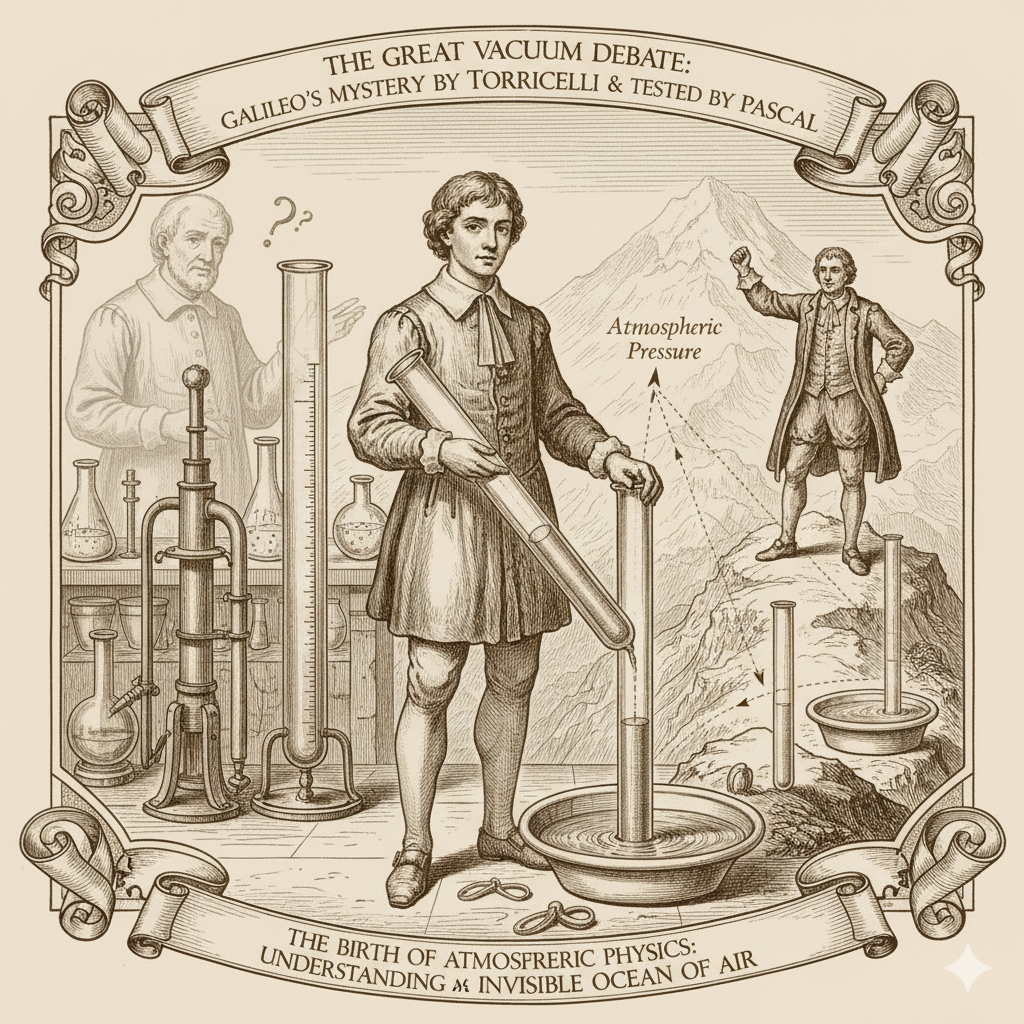
Years later, Galileo’s student, Evangelista Torricelli,
picked up the puzzle his master had left behind.
He asked a daring question:
“What if it isn’t the vacuum that stops the water…
but the air above us that pushes it up?”
He suspected that air itself — though invisible — had weight.
That it pressed down on everything, like an ocean we live inside without realizing it.
But to prove it, he needed a heavier liquid —
something that wouldn’t rise 33 feet.
He turned to mercury,
dense, shimmering, and mysterious.
In 1643, he filled a glass tube with mercury, sealed it,
and inverted it into a basin of the same metal.
The mercury fell —
but not all the way.
It stopped, leaving an empty space above it — a vacuum.
The height of the mercury column stood steady at about 76 centimeters.
And Torricelli realized what Galileo had only imagined:
The column wasn’t being held by nature’s fear —
it was being held by the weight of the air itself.
The first barometer had been born.
A device that could measure the invisible ocean pressing down on us all.

The Day the Air Moved Mountains
But could air’s weight truly change?
Was it the same at sea as it was at the summit of a mountain?
In 1648, Blaise Pascal, the philosopher and mathematician,
decided to find out — not with words, but with altitude.
He asked his brother-in-law to climb Puy-de-Dôme,
a dormant volcano in France, carrying one of Torricelli’s barometers.
At the mountain’s base, the mercury stood tall.
As he climbed higher, step by step,
the column fell lower — slowly but surely.
At the summit, the mercury had dropped by several centimeters.
The air above was thinner — lighter — and the barometer felt it.
Pascal had proven what no one had dared to believe:
The atmosphere wasn’t empty.
It was a vast sea of air —
one that pressed down on us,
stronger at the valley, gentler on the peaks.
From Horror to Harmony
In less than half a century,
the idea that terrified Galileo’s builders became a revelation that reshaped science.
The 33-foot horror had given birth to the measure of the heavens.
From water to mercury, from Florence to the French peaks,
the weight of air — once unthinkable — became a tool for measuring storms,
predicting weather, and unlocking the secrets of pressure.
The barometer wasn’t just an invention.
It was the moment humanity realized that even the invisible has weight.

At Kousain, we carry that same spirit —
to look beyond what’s seen, to measure what’s felt,
and to find logic where others see mystery.
From the forces that shape bridges to the pressures that test our structures,
we honor those who dared to question the invisible —
because in every great design,
the unseen is what truly holds everything together.