Where the River Met Its Rival
Two thousand years ago, near the southern hills of France,
the Gardon River carved its way through a limestone gorge —
a deep, rugged wound that stood between a mountain spring and the thirsty city of Nemausus (modern-day Nîmes).
Most builders would have gone around the gorge.
But the Romans didn’t go around problems.
They went through them — with geometry.
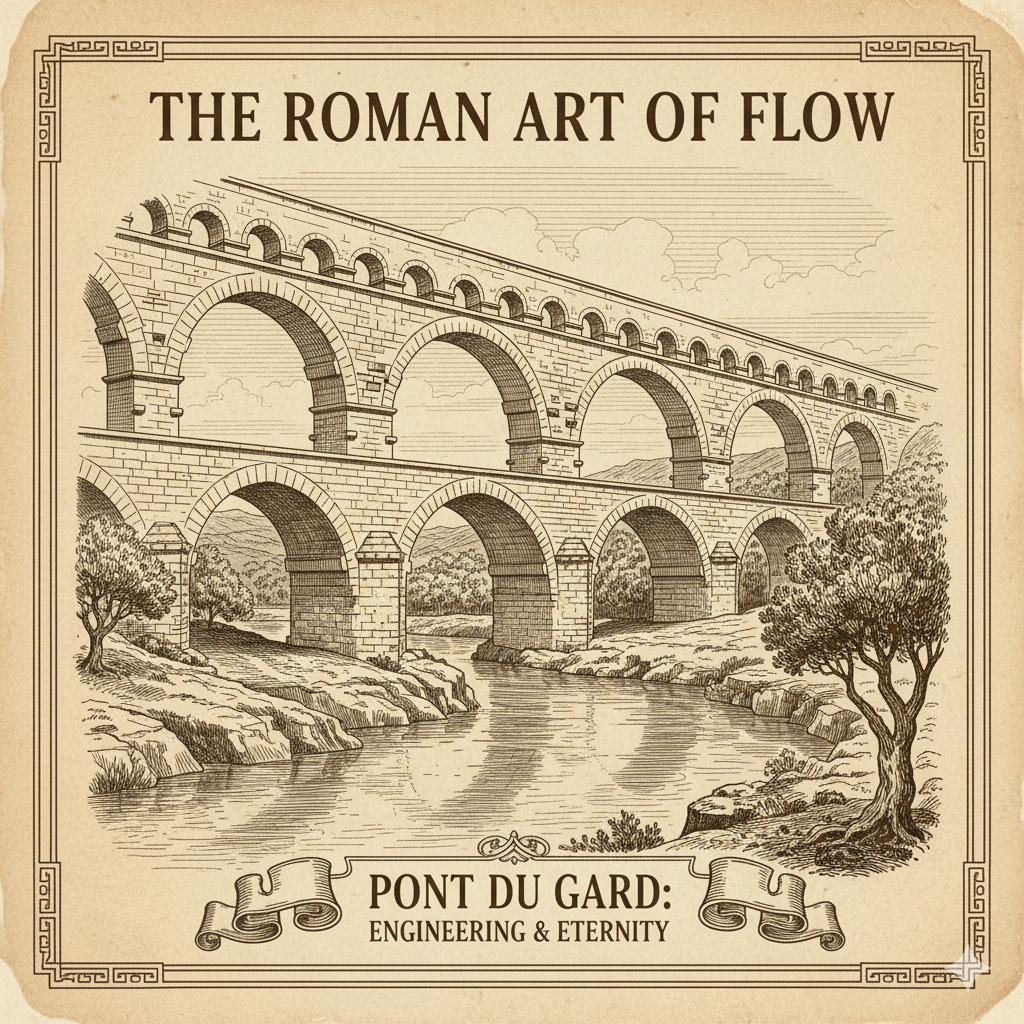
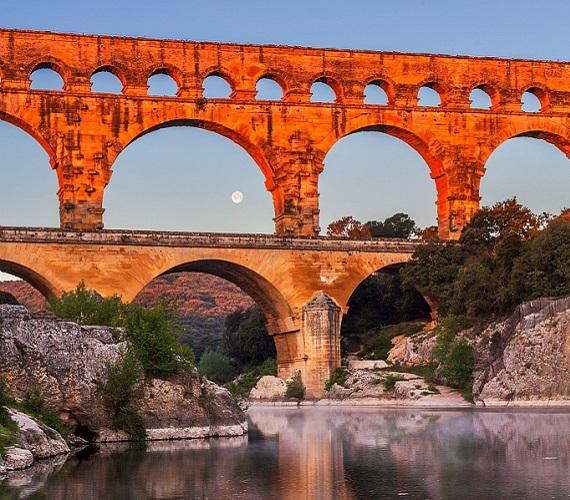
So in the 1st century AD, they built the Pont du Gard —
a three-tiered aqueduct bridge nearly 50 meters tall and 275 meters long,
carrying water high above the valley,
so gently that the slope dropped only 34 centimeters per kilometer over its entire 50-kilometer journey.
It didn’t just bridge a river —
it bridged nature and precision.

The Perfection of the Arch
From an engineering perspective, Pont du Gard is stone logic made visible.
The structure consists of three tiers of arches,
each one perfectly proportioned to distribute load and minimize material.
- The lower level carries six massive arches that resist the thrust of the upper levels.
- The middle tier holds eleven arches, each smaller, to reduce cumulative weight.
- The topmost level, where the water channel lies, uses 35 even smaller arches — a light crown atop a heavy base.

This is not decoration — this is force management.
The Romans understood that an arch in compression never fails,
so they built with voussoirs — wedge-shaped stones that press against each other,
redirecting weight into the piers and down to the rock foundation.
No mortar.
No steel.
Just gravity — locked in geometry.
That’s why it still stands.

The Gradient of Genius
But the true brilliance lies not in the arches,
but in what flowed above them.
The channel, or specus, carried water with a slope so precise that even modern surveyors admire it:
a total drop of only 17 meters over 50 kilometers.
That’s a gradient of 1 in 3,000.
For comparison, modern pipelines often use steeper slopes to maintain flow.
How did they achieve that in the 1st century AD — with no lasers, no GPS, no modern levels?
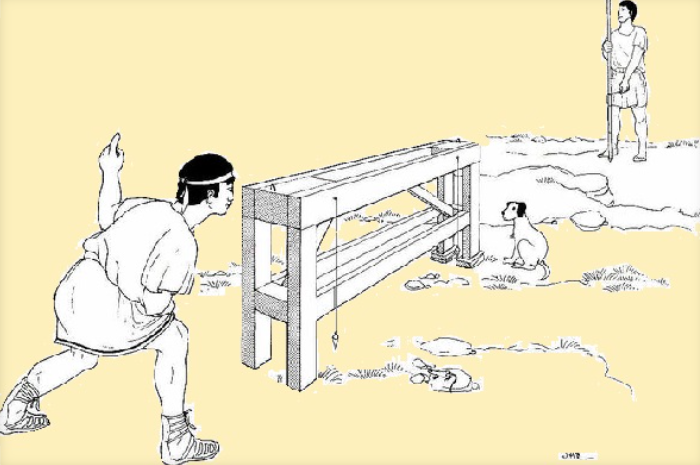
They used a simple wooden chorobates, a beam with a water trough that acted as a spirit level.

They aligned sightlines from ridge to ridge using torches, cords, and pure intuition.
And somehow, the flow reached Nîmes so smoothly that water entered the city’s fountains without turbulence.
The Material Symphony
Pont du Gard is made from local yellow limestone,
cut from nearby quarries and lifted by cranes powered by human treadmills.
Each block — some weighing up to 6 tons — was precisely shaped to fit into its arch,
joined without mortar, only with the friction of perfection.
The bridge’s asymmetry is subtle:
the piers are thicker at the base,
tapering slightly upward to reduce weight and visual heaviness.
It’s both structural optimization and aesthetic control —
proof that Roman engineers were artists of proportion long before Brunelleschi or Gaudí ever drew a line.
Two Millennia of Endurance
Pont du Gard survived floods, erosion, wars, and neglect.
At times, it carried carts and travelers instead of water.
But even stripped of its purpose, it never lost its balance.
That endurance isn’t luck — it’s engineering foresight.
The Romans designed the piers with cutwaters, sharp triangular noses that split river flow and reduce scouring.
They built flexible joints where arches meet piers to absorb small shifts without cracking.
In short — they designed for resilience,
long before the word existed.
It’s why the bridge still stands tall after 2,000 years —
not as ruin, but as reference.
The Legacy of the Arches
Pont du Gard was never just a structure —
it was a school.
Its principles became the grammar of every aqueduct that followed:
- The Aqueduct of Segovia (Spain) — nearly 900 meters long, still intact, still carrying the original stones.
- The Valens Aqueduct (Istanbul) — blending Roman and Byzantine engineering to feed a city that spanned empires.
- The Pont de les Ferreres (Spain) — smaller, but so precise in its slope and arch geometry that it’s still studied by engineers today.
- The Aqua Claudia and Aqua Marcia (Rome) — the arteries of an empire, feeding baths, fountains, and daily life for a million people.
Each one borrowed the same wisdom:
trust the arch, respect the slope, and let water do the work.


The Equation That Never Aged
If Pont du Gard were designed today,
its math would still check out.
Load distribution, thrust lines, and hydraulic gradient —
all within modern safety limits.
Its geometry is timeless not because it’s ancient,
but because it’s correct.
It’s the rare structure where the physics is so perfect,
that even erosion bows to it.
That’s why civil engineers don’t just admire it.
They measure themselves against it.
At Kousain, we look at Pont du Gard and see more than history.
We see a philosophy:
that structure and nature are partners, not opponents.